Showing posts with label Alan Eagleson. Show all posts

Friday, March 21, 2014

1933


From the big scrapbook of time, here’s a look at Canada in 1933--


  The thrifty 1933 Willys 77 Sedan lists for $610 and promises to deliver 10.6 to 12.3 kilometres per litre  (30 to 35 miles per Imperial gallon). This will be the last year for the marque to be built in the Toronto factory.

January 1: The year gets of to a dismal start. There are 1.35 million Canadians on the dole; many more who are too weary to keep looking. The average income has plummeted by 48 percent since 1929 to just $247 a year.

January 8: A five-hour riot at the Dorchester Penitentiary in Dorchester, New Brunswick pits the 476 inmates against the 40 guards. Rumours have it that the fracas began because cells are overcrowded and there is not enough food to go around.

January 25:  Alden Nowlan is born in Windsor, Nova Scotia. He will grow up and move to New Brunswick where he will distinguish himself as one of the world’s great poets. He will win the Governor General’s Award for poetry in 1967 and be the Writer in Residence at the University of New Brunswick from 1969 until his death in 1983.

January 31: Camille Joseph Wilfred Henry is born in Quebec City. He will grow up to be an NHL player. “The Eel” will retire in 1970 and die at the age of 64 in a Quebec City hospital from complications resulting from diabetes.

February 23: As a result of a controversial ruling, Canadians may now be sent to prison for expressing a belief in Communism. 

March 2:  King Kong opens in New York City. The celluloid drama is a smash hit and stars Fay Wray who is a native of Cardston, Alberta.

March 9:  Melvin Douglas (Mel) Lastman is born in Toronto. He will grow up and enter politics. He will serve as mayor of North York and then Toronto from 1972 to 2003--a record unbroken as the longest-serving mayor in any city on the planet.

April 13:  The Stanley Cup goes home with the New York Rangers who stomp the Toronto Maple Leafs three games to one.

April 24: Alan Eagleson is born in St. Catherines, Ontario. He will grow up to be lawyer and hockey promoter.  He will be convicted of fraud and embezzlement in the 1990s. He will be disbarred from the legal profession and stripped of membership in the Order of Canada.

Cheerio yo-yos are made in Toronto. They are the hands-down favourite of Canadian and British players.

May 6: The yo-yo craze hits town as the Vancouver Sun organizes a competition. The first prize is $50 and it goes to Jimmy Wigglesworth. Harvey Lowe is the best in the land. He will teach and compete until his death at the age of 90 in 2009.


May 8: An RCMP Inspector is killed and three other Mounties are injured in Saskatoon as police do battle with some 300 unemployed men.

May 15: Thousands flock to the port of Montreal to see the Bluenose—the fastest schooner in the world. The undefeated Queen of the North Atlantic is skippered by Angus Walters who is piloting the ship to the World’s Fair in Chicago where the Bluenose will represent Canada as a floating pavillion at the Century of Progress.


May 16: Winnipeg police raid the Canadian Fascist Party’s headquarters. The party makes no bones about being pro-Hitler and openly anti-Jewish.

May 23: Parliament orders the CPR and the CNR to cooperate in order to make passenger rail services more economical to the public. The two railways will lose their passenger train services in 1975 when VIA Rail is created as a new Crown corporation.

May 24: Marian Engel is born in Toronto. She will grow up to become one of the nation’s foremost and most controversial writers. She will win the Governor General’s Award in 1976 for Bear, her unusual love story about a librarian and a bear. She will die in 1985.

May 27: The World’s Fair opens in Chicago. Canada is represented by the Bluenose—the finest and fastest schooner the sea has ever known. More than 22 million people will visit the Century of Progress and many will tour the Bluenose.

May 29:  Marc Carbonneau is born in Quebec. He will grow up to become a political activist who believes in using violence for change. As a member of the Front de Liberation du Quebec, he will be convicted of kidnapping British Trade Commissioner James Cross and exiled to Cuba. He will return to Canada in 1981 and serve his sentence. In 2006 he will run a construction company.

July 14: Robert Bourassa is born in Montreal. He will grow up to become a politician and Premier of Quebec. His whole career will be pitted against political opponents who want Quebec to become a sovereign state. He will step down from office in 1994 and die of skin cancer in 1996.

July 19: The Cooperative Commonwealth Federation holds its first convention. Delegates debate change at its convention in Regina. They vote that the party will not endorse violent change. The Regina Manifesto plans to nationalize key industries in transportation, commerce and hydroelectric power when elected.

July 20: Police in Winnipeg are injured as they clash with protesters who demand that the Winnipeg General Hospital reopen its outpatient clinic. The riot is fierce and reserves are called up. With the help of batons and tear gas they break up the conflict.

August 7: Hollywood’s Number One box office star, Marie Dressler is the first woman to appear on the cover of Time magazine. The Oscar winning actress is from Coburg, Ontario.

August 17:  The Mayor of Toronto orders police to arrest anyone wearing a swastika. The symbol has already become synonymous with troublemaking and racial hatred.


October-- Lord Amulee releases his Royal Commission report on the state of affairs in the Dominion of Newfoundland. He blames all problems on fiscal mismanagement and corruptions. He does not take into account the worldwide depression.

October 17: Emily Murphy dies in her sleep at home in Edmonton. She is 65 years old. She was active in the women’s rights movement and the first woman to be appointed as a judge in the British Empire. She will be honoured with a statue on Parliament Hill and her likeness will be engraved on the back of the $50 bill issued in 2004.
Squares, by Guido Molinari will sell for $21,850 in 2002.

October 23:  Guido Molinari is born in Montreal. He will grow up to become a highly successful abstract artist, have exhibitions worldwide and win prestigious prizes for his colourful works. He will die in Montreal in 2004.

November 11: Wreaths are laid at cenotaphs across the country on the 15th anniversary of the end of the Great War. There may be trouble brewing in Europe as Adolph Hitler was made Chancellor of Germany in March. His National Socialist Party is on the extreme right.

November 26: Robert Goulet is born in Lawrence, Massachusetts, the son of French-Canadian parents. He will move with his mother to Alberta and grow up to become a great singer and movie star with a career that spans six decades.
Colonial House in St. John's has been the seat of government and House of Assembly since 1850.

November 28: It is a black day in St. John’s as legislators vote to give up Newfoundland’s Dominion status. In light of the island nation’s bankruptcy, the country will return to colonial status and be administered by Britain.

November 30:  General Sir William Arthur Currie is dead in Montreal at the age of 57. As the first Canadian commander of the Canadian Expeditionary Force in the Great War, Currie is by all accounts considered to be one of the most successful Allied generals and one of the best strategists in military history.

December 5: Canadian breweries and distilleries gear up for anticipated big business orders as US President Franklin Roosevelt officially revokes Prohibition.

December 9:  The Toronto Argonauts trounce the Sarnia Imperials to earn the Grey Cup. The final score is 4 to 3.

1933 Ford V-8 De Luxe  Fordor Sedan

December 21:  Ford will issue a dividend to stockholders, despite a $1.7 million loss. President W.R. Campbell says the company is in a strong position with $6 million in the bank. The company has produced only 9,177 passenger cars for the domestic market. Sixteen Ford automobiles were shipped to the Dominion of  Newfoundland though only three had V-8 engines.
1932 Frontenac

December 22: Dominion Motors Limited shutters the factory doors forever, its Frontenac automobile yet another victim of the Great Depression.


Workers at General Motors in Oshawa build 2,266 Pontiacs in 1933. Shown here is a Special Four-door Sedan.


Wednesday, January 9, 2013

1998

From the big scrapbook of time, here’s a look at Canada in 1998-

Ford Escort takes the Number Six spot in sales this year.


January 1: Toronto becomes the nation’s largest city when it amalgamates with six suburbs to create a mega-city.
 
January 2: Avalanches in British Columbia kill nine people in three separate incidents.

January 4: Freezing rain stretches several thousand kilometres from eastern Ontario through Quebec, northern New York, New England, all the way to Nova Scotia. The freak storm will rage unabated for more than 80 hours. Caused by El Nino, the Ice Storm will plunge 30 million people into the dark and cold, some for weeks. Damages will add up to $7 billion and 35 people will die—28 of them in Canada.

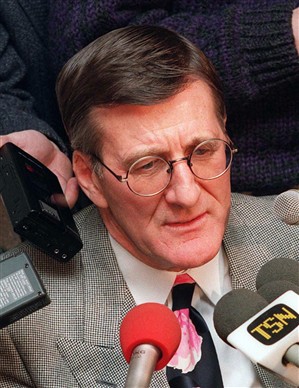
January 6:  Hockey promoter Alan Eagleson pleads guilty to embezzling NHL players’ pension money. He will be fined $700,000 and serve six months in jail. The lawyer will be disbarred from the legal profession, be stripped of his Order of Canada and be removed from the Hockey Hall of Fame.

January 7: Ottawa makes a formal apology for the past treatment of First Nation peoples—especially those who were forced to attend residential schools.

January 23: The Bank of Montreal and the Royal Bank announce plans to merge. The announcement is premature however. The federal government will forbid the marriage.


February 6: No more blue light specials for Canadians! The Hudson Bay Company buys K-Mart and turns the low-buck retail chain into Zellers stores. Zellers will disappear in 2012.

February10: Already one of the largest railways in the world, Canadian National acquires Illinois Central. CN now runs from Vancouver to Halifax and from Chicago to New Orleans. The Illinois Central name will be phased out after 2001—when grand old the railroad marks its 150th anniversary.

February 12: Diversification appears to be a good thing as the Toronto Maple Leafs buy the Toronto Raptors.

February 20: Lighthouse lead singer Robert Bruce McBride is dead of heart failure at the age of 41. He is best remembered for his hits Sunny Days and One Fine Morning.
 

February 22: The XVIII Winter Olympiad is over. Canada has captured 22 medals—giving us fourth place in medals earned at the games in Nagano, Japan.

February 25: William Ormand Mitchell is dead in Calgary at the age of 83. Born in Weyburn, Saskatchewan, Mitchell graduated from the University of Manitoba in 1943. He was editor of Maclean's  and authored many classic books including the unforgettable tale of growing up on the Prairies, Who Has Seen the Wind.  He created Jake and the Kid, a adventure series that ran for seven seasons (320 episodes) from 1950 to 1956 on CBC Radio. Schools will be named in his honour and Canada Post will remember him with a stamp in 2000.


March 6: The Ontario government apologizes to the Dionne Quintuplets and settles with them for an undisclosed amount of money after years of exploitation. The shocking tale of the five sisters was made into a movie in 1994, Million Dollar Babies.

March 12: Quebec and Newfoundland finally come to an agreement regarding power and profit sharing of the massive Churchill Falls hydro-electric facility in Labrador.


March 15: Yves Landry, president of Chrysler Canada is dead of a heart attack at the age of 60. Born in Thetford Mines, Quebec, the captain of industry was repositioning Chrysler for the future at the time of his death. The company’s profits dropped 54 percent last year.

Sarah McLaughlin.
March 22: The Juno Awards are held at GM Place in Vancouver, hosted by Jason Priestly.  Single of the Year is Building a Mystery by Sarah McLachlin who also wins a Juno for Surfacing, chosen as Best Album and another for Best Female Artist. Paul Brandt takes home a Juno as Best Male Artist.

March 23: Senator Andrew Thompson has only attended 12 sessions in the Red Chamber during the past seven years. He actually lives in Mexico. The Reform Party embarrasses him by serving burritos and having a mariachi band play in the Senate lobby until the bad publicity prompts the Senator to resign.


March 27: Ottawa announces it will compensate people who contracted hepatitis C as a result of tainted blood distributed by the Canadian Red Cross.

April 1: Hard hit two years ago, more flooding in the Saguenay River region of Quebec forces 2,000 people from their homes.

April 3: Police officers in the Royal Newfoundland Constabulary may now carry weapons. This is an historic first for the police force, established in 1729.

April 16: Louise Meilleur, the world’s oldest living person, dies at the age of 117 years and 230 days in Corbeil, Ontario. Born in Kamarouska, Quebec she lived through two world wars.

April 17: Born in Saskatoon, Dr. Dafydd “Dave” Rhys Williams is the medical officer on the space shuttle Columbia. The astronaut will spend 16 days in outer space studying micro-activity on the brain and nervous system.

April 17: The Canadian Imperial Bank of Commerce and the Toronto Dominion Bank announce merger plans. They won’t get Ottawa’s blessing, however.

April 25: Move over NAFTA. The United States government announces huge tariffs on softwood lumber imported from Canada. Americans will collect $5 billion in taxes before the dispute is settled in 2006.

April 27: Media mogul John Bassett is dead at the age of 82. He was publisher of the Montreal Gazette, owned the Toronto Argonauts and established CFTO—cornerstone of the CTV Network.

May 28: Phil Hartman is murdered by his wife while he sleeps. The Branford, Ontario born TV star is 49. His hit show, NewsRadio is one of his legacies.

June 10: An explosion rips through the Irving Oil Refinery in Saint John, New Brunswick, killing one worker. Damage is estimated at $25 million.
June 16: The Detroit Red Wings trounce the Washington Capitols in four games to win the Stanley Cup.
The Right Honourable Brian Mulroney, Canada's 18th Prime Minister.
June 17: Prime Minister Mulroney is in Toronto to host the G-7 annual summit. Leaders of the world’s seven most powerful industrial nations will tackle the thorny issue of Third World debt.

June 18: A King Air twin-engine commuter plane, bound from Montreal to Peterborough, Ontario, is forced to land in Mirabel when an engine catches fire. Nine passengers and two crew members die in the fire.
Canada, A Centennial Song is the best-selling single in 1967.
June 20: Bandleader Bobby Gimby is dead at the age of 69. A member of The Happy Gang, heard on CBC Radio from 1937 to 1959, he is best remembered for his bilingual song, Canada, A Centennial Song, written for Centennial year celebrations.

June 24: Forestry giant Macmillan-Bloedel announces the company will end the practice of clear cutting in its old growth forests.

July 14: The Seattle Times reports that next week a new radio station will open on Vancouver Island. It will be ORCA-FM, found at 88.5 on the radio dial. The station will be 'all orca all the time' as the transmitter broadcasts whale sounds to the orca pods that frequent the area.

July 20: Extra! Extra! Read all about it! The Financial Post has a new owner as media giant Southam purchases the paper from Sun Media. It will be completely revamped and relaunched as The National Post on October 27. It will be the polar opposite of The Globe & Mail, billed as Canada's National Newspaper.

August 10: Forest fires rage through northwestern British Columbia. The premier orders 8,000 people evacuated from Salmon Arm. Another 10,000 residents are on evacuation alert, should the inferno reach town. More than 600 firefighters and a dozen helicopters are battling the blaze.


August 20: The Supreme Court rules that Quebec may not legally secede from Confederation without the approval of the federal government.

August 28: It has not been a good year for the dollar. The Loonie hits an all-time low of 64.02 cents US.

September 2: Air Canada is strike bound as its 2,100 pilots walk off the job. It is their first strike in the company’s 61-year history. Pilots demand better pay and better working conditions. They complain that at $64,100 a year they make 30 to 50 percent less than pilots working for other airlines.

September 2: Swissair Flight 111 is on its way from New York to Geneva when fire spreads through the plane. The McDonnell Douglas MD-11 crashes into St. Margaret’s Bay off the coast of Peggy’s Cove, Nova Scotia. The craft breaks up upon impact with the water. All 229 on board are dead. Unidentified remains will be buried at a memorial wall at Bayswater Provincial Park.

September 22: An estimated 20,000 angry protesters rally on Parliament Hill. They are opposed to the national gun registry scheme about to be introduced by the federal government.

Eric Malling


September 28: Host of CBC Television’s The Fifth Estate and CTV’s W-5, investigative journalist Erik Malling is dead at the age of 52, the result of of a brain hemorrhage after falling down a flight of stairs at home.

Pauline Julien


October 1: Chanteuse, composer and actress Pauline Julien is dead. Born in Trois-Rivieres, Quebec, she committed suicide in Montreal upon learning she had a debilitating brain disease.

The United Nations' flag.
October 8: Member nations have voted. Canada is one of ten countries elected to a two-year seat on the United Nations Security Council.

October 14: The nation’s first diamond mine opens. Located 300 kilometres northeast of Yellowknife and operated by BHP Billiton, the Ekati mine will produce some three million carats of rough diamonds annually.

October 27: The National Post makes its debut. The newspaper is intended to offer a small “c” conservative voice of reason and point of view.


November 13: Michel Trudeau, son of the former PM, is crushed to death in an avalanche while skiing in British Columbia. He is 23 years old.

November 22: Winnipeg plays host to the 86th Grey Cup. The Calgary Stampeders square off against the Hamilton Tiger Cats for the Canadian Football League's trophy. It will go home with the Stamps; the final score is 26 to 24.

November 26: Don Morin, Premier of the Northwest Territories, is forced to resign over a conflict of interest charge. He is guilty of arranging the illegal shipment of government-owned bison to a personal friend.


December 9: Shaughnessy Cohen, Member of Parliament for Windsor-St. Claire, rises to speak in the House of Commons and collapses as the result of a cerebral hemorrhage.

December 14: It’s official: Paul Martin, federal Minister of Finance, forbids the nation’s chartered banks to merge.
Kathryn Hepburn and David Manners in Bill of Divorcement, a 1932 Hollywood movie from RKO.

December 23: Halifax-born actor David Manners is dead at the age of 98.  He starred in many movies with all the leading ladies of the day including Katheryn Hepburn and Barbara Stanwyck.

The Ford Taurus takes eighth place in domestic sales this year.

December 31: The top ten selling cars throughout the land this year are the Honda Civic. the Chevy Cavalier, the Pontiac Sunfire, the Toyota Corolla, the Ford Escort, the Honda Accord, the Chevy Malibu, the Ford Taurus, the Toyota Tercel and the Toyota Camry.