Showing posts with label Sandra Post. Show all posts

Thursday, February 13, 2014

1948


From the big scrapbook of time, here’s a look at Canada in 1948-

Folks like the Monarch, now in its third year on the market. Workers at Ford of Canada in Windsor build 6,682 of them. The four-door sedan lists for $2,968. 


January 15: Andrew Jordan Jones is born in St. John’s, Newfoundland. He will grow up to be a comedian and TV star appearing in the classic comedy series CODCO and This Hour has 22 Minutes.

January 16: Clifford Charles Devlin Thorburn is born in Victoria, BC. He will learn to play snooker, earn the nickname “The Grinder.” He will win the 1980 World Snooker Championship. Cliff will be made a Member of the Order of Canada in 1983.

January 19: Francis Joseph (Frank) McKenna is born in Apohaqui, New Brunswick. After serving as Premier of the Picture Province from 1987 to 1997 he will step down from office and become our shoot-from-the-hip, no-nonsense Ambassador to the United States in 2005.

February 6: It’s gold for Canada and Canada’s Sweetheart as Barbara Ann Scott takes top honours for figure skating at the Winter Olympics in St. Moritz, Switzerland.

February 14: For the second year in a row Barbara Ann Scott wins the World Figure Skating Championship.

February 20: The Dominion Bureau of Statistics tells us that there are 3,136,000 homes in the country of which 90 percent have a radio and 50 percent have a telephone.

March 11: British officials announce that the future of Newfoundland and Labrador will be decided in a referendum. There will be three choices: return to independent Dominion status, stay as a colony for the next five years or join Canada in confederation.

March 20:  It’s a boy for Mr. and Mrs. Doug Orr of Parry Sound, Ontario. Robert Gordon will grow up to be the most dazzling defenceman that the NHL will ever see. Bobby will be forced to retire at the age of 31. He will be inducted into the Hockey Hall of Fame and made an Officer of the Order of Canada in 1979.

April 1: The 40-passenger Northstar Skyliner makes its debut on a Trans-Canada Air flight from Montreal to New York City.

April 14: For the second year in a row, The Toronto Maple Leafs triumphantly skate off the ice with the Stanley Cup, this time snatching it from the Detroit Red Wings in four games.

April 18: Officials at Ford Canada unveil the Meteor as a 1949 model. The mid-priced offering will fit between Ford and Mercury. It’s a hit and Meteor will rocket to third place in sales, capturing nearly 11 percent of the domestic sales pie.

April 26: More than 2,500 homeless refugees have nowhere to go as floods sweep Manitoba. There is more rain and snow in the forecast and the floodwaters are now only three blocks from Portage and Main.

May 24: Spring means flooding and the Fraser River overflows its banks. Volunteers will be joined by the Royal Canadian Army. Folks work around the clock for three weeks solid to protect homes. Ten people will die, 2,300 dwellings are damaged or completely destroyed. Vancouver will be cut off from the rest of the country for three weeks.


June 3: Newfoundlanders line up at the polls to determine the fate of their homeland. When the votes are counted they add up to 69,000 votes for self-government, 64,000 for union with Canada and 22,000 want to remain a colony of Britain. Another referendum will be held on July 22.

June 5: Sandra Post is born in Oakville, Ontario. She will grow up to swing a mean club on the golf course and win eight LPGA tournaments. In 1988 she will be elected to the Canadian Sports Hall of Fame and made a Member of the Order of Canada.

June 8: Cecil George Harris of Rosstown, Saskatchewan is pinned under his tractor and bleeds to death. He scratched his will on the tractor's fender with a penknife. It will be upheld as a legal holistic will by the Law Courts and his widow will inherit the farm.
 

June 24: Members of the Toronto Board of Education pass a resolution to pay women teachers the same salary as their male counterparts. The annual average pay for a teacher is $3,500 and taxpayers will have to pick up the $120,000 tab needed to make up the shortfall.

June 30: Murray McLauchlan is born in Paisley, Scotland. His family will move to Canada when he is five. He will grow up to be folk singer and songwriter, winning 20 Junos. His first gold record will be Farmer’s Song.

July 8: Raffi Cavoukian is born in Cairo, Egypt. When he is ten, his parents will immigrate to Canada. Raffi will grow up to become a popular children’s entertainer; loved by millions of kids for such hit songs as Banana Phone, Down by the Bay and Shake My Sillies Out. He will be made a Member of the Order of Canada in 1983.

July 21: Arthur Hindle is born in Halifax. He will grow up to be an accomplished screen and TV actor playing the role of Jeff Faraday in Dallas. The Gemini winner will direct and star in the Showcase series, Paradise Falls.
Newfoundland and Labrador are coloured red on this map.

July 22: The polls are closed and the votes are counted. 47.6 percent of the population wants Newfoundland to be independent again and 52.2 percent favour Confederation with Canada. Britain’s oldest colony will enter into Confederation as Canada’s tenth and newest province next year.

August 1: Ottawa drops the sliding excise tax on new cars. That’s a good thing because it has nearly destroyed the industry since its introduction last November.

August 2: Robert Keith Rae is born in Ottawa to a career diplomat and his wife. Bob will be the first NDP Premier of Ontario, be named Chancellor of Sir Wilfred Laurier University in 2003 and serve as interim leader of the federal Liberal Party from 2011 to 2013.
Prime Minister Mackenzie King will appear on the $50 bill when it is introduced in 1975.

August 7: William Lyon Mackenzie King officially retires after 21 years as Prime Minister. The Liberal Party chooses Louis St. Laurent to lead the Grits. “Uncle Louis” is a perfectly bilingual lawyer from Quebec City and most recently served as Minister of External Affairs in the King government.

August 18: As 400 employees watch, the press is on hand as the first Studebaker rolls out the doors of the new plant in Hamilton, Ontario. It is a blue four-door Champion. Workers will build exactly 3,000 Champions before the model year ends.
Margaret Trudeau will write about her bi-polar condition and be the honourary patron of the Canadian Mental Health Association.

September 10: Margaret Sinclair is born in Vancouver, BC. She will grow up and obtain a degree in English Literature from Simon Fraser University. When she is 22 years old, she will marry Pierre Trudeau, our 15th Prime Minister. Margaret will become an author, actress, photographer, talk show host,


September 24: Phil Hartman is born in Brantford, Ontario. He will grow up to become one of the funniest people on stage or in front of a camera, appear on Saturday Night Live for eight seasons and star in the TV sitcom NewsRadio. He will be murdered by his wife in 1998.

October 15: October 15: Ernest D'Israeli Smith is dead at the age of 94. Born near Stoney Creek, Ontario. E.D. and his sons founded the food giant that bears his name. The company's first product was ketchup but expanded to jams, jellies and pie fillings. The family also owned the Canadian rights for HP Sauce and Lee & Perrins Worcestershire sauce. Mr. Smith served as a Conservative Member of Parliament until he was appointed to the Senate where he served from 1909 until 1946.

October 17: Margaret Ruth Kidder is born in Yellowknife, NWT. The budding actress will change her name to Margot and star in the Superman movies as well as The Amityville Horror and other Hollywood films.

November 24: Spider Robinson is born in New York City. The Hugo and Nebula award winner will move to Canada in his twenties and become one of the world’s most renowned science fiction authors.

December 11: The terms of Confederation between Newfoundland and Canada are agreed upon and the document signed this evening in a royal ceremony held in the Senate Chamber in Ottawa. God Save the King and O Canada are played but no one can find the music for Ode to Newfoundland.

December 14: The Supreme Court overturns a ban on the sales of oleomargarine throughout the Dominion. Though suspended during World War One, the ban on the butter substitute has been in effect since 1886. Margarine may not be coloured yellow. That will only change in 1995 but Quebeckers will eat uncoloured margarine until 2008.

The 1948 Studebaker Champion Regal De Luxe is Studebaker's economy model.


The newest manufacturer in the Dominion in Studebaker. Now located in Hamilton, Ontario, the company’s cars and trucks had been imported from the United States since its factory in Windsor, Ontario was shuttered in 1935.


Monday, October 28, 2013

1968


From the big scrapbook of time, here’s a look at Canada in 1968-


From St. John’s to Victoria there will be 364,310 babies born in 1968. Lucky ones get to ride home from hospital in one of the 9,357 Vauxhalls imported from Britain by GM Canada. You can see this drawing in colour at  HYPERLINK "http://www.indrart.ca" www.indrart.ca

January 19: Will that be cash or Chargex? Shoppers in Lethbridge, Alberta and the rest of the country will have to think about the answer to this question for many years to come.  The Toronto-Dominion Bank, The Royal Bank of Canada, the Canadian Imperial Bank of Commerce and the National Bank of Canada have banded together to introduce a new credit card. Chargex instantly stimulates the economy with $300 million worth of new credit. 


February 7: With visibility at zero, Flight 332 belonging to Canadian Pacific Airways overshoots the runway and crashes into a building at Vancouver airport. Only one of the 62 passengers and crew on board the Boeing 707 is killed.

February 16: The Tenth Winter Olympiad closes in Grenoble, France. Canadian athletes bring home one gold, one silver and one bronze medal.   It’s Gold and Silver for Nancy Green, who places first in the giant slalom and earned a Silver medal for another skiing event. 


March 7: Advancing technology during the Cold War brings about the necessity of updating the old NORAD system. Ottawa and Washington will collaborate on a new protection plan in which aircraft will constantly fly throughout the Arctic with sensitive monitoring equipment to make sure the USSR stays out of our back yard. The new plan is called Airborne Warning and Aircraft Control System or AWACS for short.


March 7: The Bell Telephone Company of Canada Limited gets a new name. Bell Canada is a whole lot faster to say but folks will still call the telephone provider “Ma Bell” or “The Bell.”


March 16: The chartered banks and gold dealers have no gold to sell as the federal government suspends trading in the precious commodity. 


March 23: The last Mercury truck rolls off the line at Ford's Oakville, Ontario plant. The brand is phased out after 22 years--another casualty of AutoPact.


April 1: The old Board of Broadcast Governors makes way for the new Canadian Radio-Television Telecommunications Act. The first chairman of the CRTC is the most trusted civil servant in the country, Pierre Juneau. He will create Canadian content requirements for radio and television. The Juno Awards will be named for him.


April 2: Montreal Mayor Jean Drapeau institutes Canada’s first lottery. His Worship hopes the profit from the gambling scheme will pay off the $250 million bill left from Expo ’67—the World’s Fair.

April 12: The New Brunswick legislature passes into law a bill that makes the Picture Province the first to offer all government services to citizens in both official languages.

April 12: Hamilton, Ontario lawyer Lincoln Alexander will sit in the House of Commons as a Progressive Conservative, representing the riding of Hamilton West. He is the first African-Canadian to be elected to Parliament. He will also become Lieutenant Governor of Ontario.

On top of the world, no matter which direction they look, it will be south.
April 1: Ralph Plaistead and Jean-Luc Bombardier have led a joint Canada-US expedition to the North Pole. The 42-day trip is made by four snowmobiles. Jean-Luc, nephew of snowmobile inventor Joseph Armand Bombardier, is the first Canadian to reach the North Pole.


April 20: Pierre Elliot Trudeau is sworn in as the nation's 15th Prime Minister after Lester Pearson steps down. The press speculates that the new PM will call an election shortly.

Ford's compact Falcon is built in the St. Thomas, Ontario plant.
April 22: The 11,000 employees at Ford of Canada end a six-day strike.


Red Berenson suits up for the Blues.
May 11: The Habs beat the St. Louis Blues four games to zip for the honour of taking home the Stanley Cup. This is the first year for the bigger NHL which now has twelve teams.


May 11: The Toronto Transit Commission opens its new east-west subway extensions to the public. The system is now 9.6 kilometres longer than before.

May 15: The Centennial Planetarium, with the 280-seat Star Theatre opens in Winnipeg.

The US government has maintained a consulate in Quebec City since 1834.
May 24: The United States Consulate in Quebec City is damaged by a bomb blast. The FLQ claims the act as part of its struggle to make Quebec an independent nation.

Soaring 105 metres (344 feet) into the air, the new home for Radio-Canada and the CBC towers over Montreal.
May 24: The sod is turned for Maison Radio-Canada in Montreal. The 23-storey landmark will open in 1972. La Maison will be home to Radio-Canada, CBC and Radio Canada International.

May 27: Walter O’Malley—chairman of the National League’s expansion committee announces that a group of investors has put up $10 million to bring major league baseball to Montreal. There is no word as to what the team will be called but Royals, Nationals and Expos are names being put forward.

Shirley M. Jeffery is ordained as a minister of word and sacrament in the Presbyterial church.
May 29: The Presbyterian Church of Canada ordains its first woman pastor.

June 1: Queen Elizabeth II officially proclaims the flag of Alberta.
June 1: The nation’s first heart transplant patient is dead. Dr. Pierre Grondin at the Montreal Heart Institute tells reporters that Albert Murphy died as a result of complications from the anti-coagulants used to stabilize the 58-year old patient.

June 3: The Royal Canadian Mint announces it will replace the silver in coins with a much less expensive nickel alloy beginning next month.


June 9: Folks from St. John’s to Victoria warm up their Northern Electric, Marconi and Electrohome TV sets to watch federal leaders Pierre Trudeau, Robert Stanfleld, Tommy Douglas and Real Caouette in the first-ever televised leaders’ debate.

June 22: Toronto’s 3,700 outside workers--including garbage collectors—walk off the job.


June 24: Golf pro Sandra Post of Oakville, Ontario wins the US Ladies' PGA Championship. She is the first rookie and the first foreign player to win the prestigious title. Sandra will be inducted into the Canadian Golf Hall of Fame in 1988 and receive the Order of Canada, C.M. in February 2004.


June 24: Prime Minister Trudeau attends the St. Jean Baptiste Day parade in Montreal. The celebration turns ugly when separatists pelt him with rocks and bottles. The PM stands his ground as the TV cameras record the incident. His refusal to run for cover is seen as a sign of strength and courage.


Red: Liberals, Blue: Conservatives; Orange: New Democrats, Green: Social Credit
June 25: The campaign is over and the votes are counted. The Grits have swept the federal election, taking 154 seats in the House of Commons. The Tories have 72 seats in the new House, the New Democrats 22 seats and Social Credit has 15. It is the country’s first majority government in a decade. Analysts say the key to the smashing victory is the charm of the charismatic new Prime Minister and call the phenomenon “Trudeaumania.”

June 30: The Husky Tower opens officially in Calgary as Alberta Premier Manning cuts the ribbon. The 190-metre tall structure took 15 months to complete and cost $3.5 million. Its name will be changed to the Calgary Tower in 1971.

July 10: All aboard! CN Passenger Services offers great deals.


July 18: No need to check the mail box, 24,000 postal workers are on strike.

July 22: The beautiful and historic Basilica in St. Boniface, Manitoba is destroyed by fire. Spectators clogged the bridge over the Red River, delaying firefighters from getting to the scene promptly.


August 8: The Posties have voted to return to work. They have guaranteed rights and benefits, a new grievance process and consultation between union and management. The workers accept a raise of 39 to 45 cents an hour. Postal workers can expect nice fat cheques in the mail; the deal is retroactive to August 1 of last year.

August 12: Captain Angus Walters is dead at the age of 86 in his hometown of Lunenberg, Nova Scotia. He was the skipper who launched the Bluenose fishing schooner in 1921 and won the International Fisherman's Trophy Race every year until he gave up command of the ship in 1939. The Bluenose is remembered on our dime.


September 8: Dr. John McCrea’s birthplace in Guelph Ontario--now a national historic site—opens to the public for the first time. Colonel McCrea penned the poem In Flanders Fields only days before being killed on the battlefield in World War One.


September 11: An Air Canada Viscount is hijacked on route from Saint John, New Brunswick to Toronto. Holding a gun to the captain’s head, the 23-year old hijacker demands to be flown to Cuba. The plane lands in Montreal to refuel, passengers are allowed to leave and the RCMP talk the man into surrendering. It is the first air piracy incident in this country and one of 38  worldwide this year.


September 27: Ernest Manning steps down as Premier of Alberta. The Social Credit leader has led his party to victory, seven elections in a row.


October 15: Former CBC reporter René Lévesque splits with the Liberals. He will form his own party, one dedicated to forming an independent Quebec tied to Canada through sovereignty-association. The onetime Quebec cabinet minister is voted to lead the Parti Quebecois by 2,000 delegates attending the convention in Quebec City.

October 11: Folks in Manitoba attend the opening of the Red River Floodway. The $63-million project will control flooding along the Red River and protect citizens who live near the river.


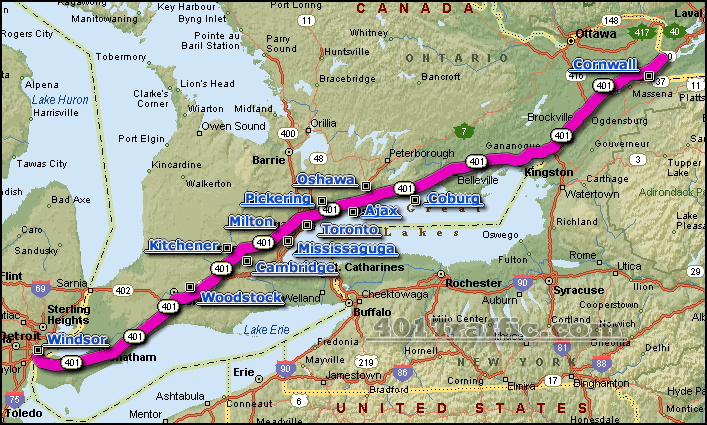
October 11: Highway 401 is now complete and dedicated today. Also known as the MacDonald-Cartier Freeway, in honour of two of the Fathers of Confederation, the 850-kilometre, limited access highway is one of the busiest in the world.

October 17: Prime Minister Trudeau tables the Official Languages Bill in Parliament. He tells members of the House that equal status for French and English is not just “a political necessity but an enrichment.”


Barbara Frum and Alan Maitland will host As it Happens in the 1970s and 1980s.

November 18: As It Happens, a new concept in news programs, airs for the first time on CBC Radio. The hosts, Philip Forsythe Smith and Harry Brown, call the day’s newsmakers to interview them. The world’s first phone-out news show will still be running strong forty-five years later and heard around the world.


November 23: Police arrest 114 students at Simon Fraser University in British Columbia. The protestors are demanding a greater voice in government.


November 30: The Grey Cup belongs to the Ottawa Rough Riders as they squeak past the Stamps. The final score is 24 to 21.


December 10: Justice is swift. Charles Lavern Beasley of Texas pleads guilty to hijacking the Air Canada flight from Saint John in September. He will spend three years as  “guest” in one of Her Majesty’s Canadian prisons, then deported to the US where he will spend another ten years in prison for a bank heist.

December 31: The Top Ten selling passenger cars during the calendar year, in order, are: the full-sized Chevrolet, the full-sized Ford, Pontiac, Volkswagen, Dodge, Plymouth, Meteor, Chrysler Newport & 300, Ford Fairlane & Torino and Chevrolet’s Chevelle.