Showing posts with label Therese Casgrain. Show all posts

Saturday, March 22, 2014

1931


From the big scrapbook of time, here’s a look at Canada in 1931--

January 1: Only 115 Ford passenger cars will be imported into the Dominion of Newfoundland this calendar year. Throughout the Dominion of Canada, dealers will report deliveries of 16,565 Ford cars, 5,030 Ford trucks, 16 Lincolns and 126 Fordson tractors. 


 January 1: Chrysler Canada will report domestic sales of 3,222 Plymouths, 1,788 Dodge Brothers, 1,231 De Sotos, 2,054 Chrysler and 9,230 trucks this year.


January 12: Now that the track extension from Hythe, Alberta is complete, the first Northern Alberta Railways Company train pulls into its new home east of Dawson Creek, BC. Citizens move their entire town to the railhead site.

January 27: Mordecai Richler is born in Montreal. He will grow up to be one of the nation’s most popular novelists. His works will include The Apprenticeship of Duddy Kravitz, Cocksure, St. Urbain’s Horseman and Joshua Then and Now. Richler will win the Governor General’s Award, the Commonwealth Writer’s Prize, the Stephen Leacock Award for Humour the Giller Prize, the Commonwealth Prize and receive an honourary doctorate from McGill university before dying of cancer in 2001.
The Romance of Canada is broadcast from CNRV in Vancouver.
January 31: The first broadcast of The Romance of Canada is heard on the CNR radio network. Never before has drama been aired on national airwaves and the series is very popular.

February – The first aircraft to land at the new airstrip in Halifax is a Curtis-Robin, guided by Atlantic Airways pilot, Robin Kent.

February 27:  It becomes illegal to import goods from the Soviet Union. This is Ottawa’s protest against the repressive Communist form of government.
Therese Casgrain has worked tirelessly for women's rights in Quebec.

March 11: The times they are a-changing. Members of the National Assembly vote to give the women of Quebec the same civil rights as men though they will not be allowed to vote in elections until 1940.


March 13: The Durant Company of Canada Limited is reorganized as Dominion Motors Limited. The automaker will continue to produce the Durant, the Frontenac and Rugby trucks in its Leaside (Toronto) factory.

March 15: Documentary filmmaker Varick Frissel wants more sensational footage of the Newfoundland seal hunt for his film. He sends The SS Viking out to sea with dynamite aboard. The TNT is to be used to “spice things up.” Somehow the wooden whaler explodes near the Horse Islands, killing the filmmaker and 25 crew.

March 22: William Shatner is born in Montreal. He will grow up to be an actor and become famous for his role as Captain Kirk in the Star Trek television show and movies. The two-time Emmy winner will appear regularly as lawyer Denny Crane in television dramas in 2006.
The Memory Board is the touching story of a couple battling Alzheimer's disease.

March 28: Jane Rule is born in New Jersey. She will grow up to teach at the University of British Columbia and write books. She will be best known for her poignant 1987 novel, The Memory Board.

April 13: Clifford Douglas “Cliff” Lumsdon is born in Toronto. He will grow up to become a champion swimmer, winning the world marathon in 1949. In 1955 he will be the first and only competitor to swim the icy 42-kilometre Straits of Juan de Fuca off the coast of British Columbia. He will be inducted into Canada's Sports Hall of Fame in 1976 and become a Member of the Order of Canada in 1982. In March 1988, a park in Toronto will be named Cliff Lumsdon Park in his honour. He will die on August 31, 1991 at the age of 60 after a successful coaching career.

April 14:  The Montreal Canadiens skate to hockey heaven for the second year in a row and earn the Stanley Cup, three games to two. The Chicago Blackhawks are the disappointed losers.


April 15: Some 6,000 hungry and unemployed men gather outside of the Manitoba Legislature while their leaders meet with the premier and demand some kind of relief. Afterwards there is a riot as the men clash with police. Many of the protesters are arrested and six are taken to hospital for injuries.
People blame Prime Minister Bennett for their poverty. When their cars no longer run, they hitch them to horses and derisively refer to them as 'Bennett Buggies.'

April 15: Prime Minister Bennett tells a crowd of unemployed men that they do not deserve “the dole.” He refuses to help them but offers these obvious Communists one-way tickets to the Soviet Union so they can live in paradise.

April 19: It’s a boy for Miller and Margaret Stewart. Son Walter is born in Toronto. He will grow up to be a journalist and broadcaster. Author of more than twenty books, many of them will be best sellers. Stewart will die of cancer in 2001.

May 28: Peter Erasmaus is dead at the age of 97. The Metis trapper and farmer served as interpreter and guide for many explorers, including the three-year loong Palliser Expedition that mapped out much of the country between Lake Superior to the far side of the Rocky Mountains.  
A farmer near Brownlee, Saskatchewan deals with another crop failure as the dust storms roll in for the second year in a row.
June 18: The 'black blizzards' won’t stop. Two of the wild wind tempests deposit more than 5 tonnes of dirt and dust on Winnipeg streets today.

June 27: It is a boy for Sam and Saidye Bronfman of Montreal. Son Charles will grow up to inherit the Seagram’s fortune and be majority owner of the Montreal Expos before selling in 1990. In 2006 Charles will be worth more than $2.5 billion and be listed as the fifth richest person in Canada. 


Soup kitchens spring up all across the land. They are the last resort for desperate people who have lost everything, including hope.
 July 1: The Prime Minister tells the nation he will submit $25 million in relief bills to Parliament. The leader of Her Majesty’s Loyal Opposition pledges to speed the bills to passage.
The yellow, orange and red portions of the map show Palliser's Triangle, the driest and  hardest hit parts of the Prairie Provinces, destroyed by drought, dust storms and grasshopper invasions.
July 5: Norman Sommerville, the Red Cross chairman, admits that the drought in Saskatchewan is “the most serious emergency Canada has ever known.”  He reports that 150,000 citizens are in need of life’s most basic necessities, including heating fuel, clothing and food.

July 10:  Alice Laidlaw is born in Wingham, Ontario. She will grow up, marry James Munro in 1951 and move to Vancouver. Sharpening her pen and, Alice win many prizes--including the 2013 Nobel Prize for Literature--for her Gothic Ontario short stories and novels including The Progress of Love and Runaway.

July 14: Ottawa announces the purchase of two million bushels of wheat to feed starving Canadians living in the Prairie Provinces.

July 15: Desperate Indians in Saskatchewan perform the illegal rain dance non-stop for 48 hours. To everyone’s surprise--except for the Indians who live on the File Hills Reserve—rain falls on the parched earth for two days solid.

August 31:  Jean Arthur Beliveau is born in Trois-Rivieres, Quebec. He will grow up to play hockey for 18 years with the Montreal Canadiens and be on ten Stanley Cup winning teams. He will retire in 1971. Jean will turn down the opportunity to be Governor General in 2004 for personal reasons but will be honoured with a stamp by Canada Post.
The 1931 Durant Model 614 Coupe.

September 3: Durant Motors marks its tenth anniversary with a 100-car dealer drive-away from the factory in Leaside, (Toronto).

September 7: The 600 miners who work in Souris Coal Fields in the Bienfait-Estavan district of Saskatchewan have had enough. The dozen companies they work for have slashed their wages. They walk off the job, demanding better working conditions. They make less than half of their counterparts in Alberta and BC.  The men and boys work ten-hour shifts, six days a week and  are paid only 25c for each tonne of coal mined. They often work in 60 centimetres of water, in tunnels so small they cannot stand up and must pay for their own dynamite.


September 23: Forced off their farms, hungry and homeless, 19 desperate families are sleeping in the halls of the Manitoba legislature.
Funeral procession for the three striking miners killed by police during the Black Tuesday Riot.
September 29:  Miners in Estevan, Saskatchewan count three dead and another 14 in jail after a wildcat strike and an attack on police as they attempted to marche to town hall. A total of 23 people were wounded in the 45-minute brawl.

October:  The Bluenose beats the Thebaud for the International Fisherman’s Trophy. This is the eleventh year in a row that the Bluenose has sailed home with the prestigious award home for Canada. The world’s fastest schooner will never lose a race and will be honoured with a place on the backside of our dime in 1937.
In 2012, The Four Seasons will operate fifty luxury hotels on six continents.


October 6: Mine owners in southeastern Saskatchewan agree to give workers and an eight-hour working day, with a minimum wage of $4 a day. Company housing rent is reduced and miners may now shop at any store they wish. Although the miners don't get to form a union, they consider it a good deal for now.

October 8: Millionaire businessman Isadore Sharp is born. He will found the Four Seasons Hotel chain in Toronto in 1960 and be one of the founders of the Terry Fox Run for Cancer.

November 10: The 4th annual Academy Awards take place in the Sala D’Oro at the posh Biltmore Hotel in Los Angeles. At the age of 63, film veteran Marie Dressler wins a Best Actress Oscar for her role as Min in MGM’s smash hit Min and Bill. Hailing from Coburg, Ontario, the industry’s top box office draw will be honoured with a stamp by Canada Post in 2008.

Maple Leaf Gardens will be home to the Leafs for 67 years. The last game will be played here on February 13, 1999.

November 12:  A crowd of 13,542 is on hand for the official opening of Maple Leaf Gardens in Toronto. Ticket holders watch the Blackhawks beat the Leafs 2 to 1.

November 14: A Toronto judge sentences seven Communists to five years behind bars for seditious conspiracy against King and Country as members of an unlawful organization.

December 5:  The Montreal AAA Winged Wheelers whip the Regina Roughriders for Lord Grey’s Cup in front of a hometown crowd of 5,112 at Percival Molson Stadium. The final score for the fall football classic is 22 to zip.
The British Empire is now the British Commonwealth.

December 11: The British Parliament passes the Statute of Westminster giving the dominions within the Empire full legal powers of their own.  Constitutional issues will be dealt with in the UK as Ottawa asks Britain to continue to handle changes to the BNA Act.
The 1931 Greater Hudson Eight Standard Sedan is imported from Detroit, Michigan.
December 30: There’s a new kid on the automotive block as Hudson-Essex Canada Limited receives its incorporation papers. Production will get underway in the Tilbury, Ontario assembly plant early next year.

December 31: GM Canada reports production of 17,866 Chevrolet cars, 3,725 Pontiacs, 1,446 Oldsmobiles, 3,582 McLaughlin-Buicks and 252 Cadillacs. Production of LaSalles is suspended for the year but the Cadillac companion car will return in 1932.

The Northern Electric Art Deco telephone is very popular with consumers in all nine provinces.
December 31: It's a sign of troubled times. The Bell Telephone Company of Canada Limited reports more disconnections than installations for the first time in its history.


The 1931 Durant Model 614.

01: Durant is a steady seller in 1931 with 1,973 sales throughout the Dominion. Built in Leaside, Ontario, the parent company in the United States will fold in 1932.

 This Model 41 Town Car is a fine example of the 270 Pierce-Arrows sold domestically in 1931.

Sunday, March 9, 2014

1940


From the big scrapbook of time, here’s a look at Canada in 1940-

 Tourist cabins are far and few between but Nash features seats that lay flat and make into twin travel beds. Lucky travellers can stop whenever, wherever they like, when they own a 1940 Nash.


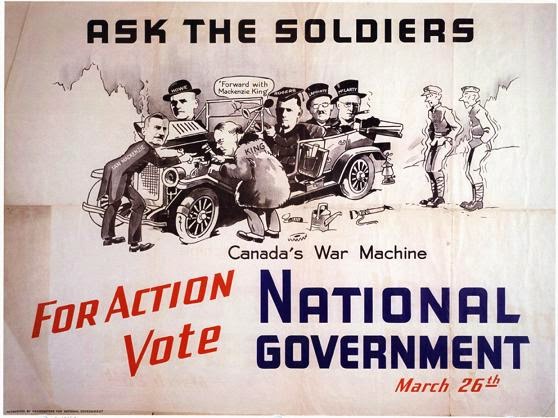
January 25: The Prime Minister surprises the country by calling a snap election only hours after the House of Commons reconvenes after Christmas holidays. Mackenzie King wants a clear mandate to lead the country through the war. It is a bold gamble on the part of the Grits; no one likes to vote in the dead of winter. 

John Buchan is a well-known novelist. His book, 39 Steps, was made into a movie by Alfred Hitchcock in 1935.
February 6: Lord Tweedsmuir, the Governor General, suffered a stroke while shaving this morning. He fell and injured his head badly. Dr. Wilder Penfield, the famous brain surgeon, will operate on His Excellency twice but the prognosis will not be good. 

Lord Tweedsmuir founded the Governor General's Prize for literature.
February 11: The Governor General is dead at the age of 64. It is the first time that our head of state has died in office. The Prime Minister will eulogize Lord Tweedsmuir in a national radio address, In the passing of His Excellency, the people of Canada have lost one of the greatest and most revered of their Governors General, and a friend who, from the day of his arrival in this country, dedicated his life to their service."


March 4: Premier Hepburn bans the viewing of Canada at War in theatres throughout Ontario, claiming that the March of Time production is “political propaganda of the most blatant kind.”  

March 6: Ken Danby is born in Sault Ste. Marie, Ontario. He will growup to be an artist best known for his 1972 painting of a masked goaltender, At the Crease.


March 7: The Agricultural Supply Board begins its work of making sure there is enough food at home and for our soldiers fighting on the battlefront. The agency will be disbanded when victory comes—but no one can imagine the war will last six long years. 


March 8: Nora Golding is born in Sarnia, Ontario. She will grow up, change her name to Susan Clark and become an actress appearing in movies like The Apple Dumpling Gang, Airport, Porky’s and The Butterbox Babies. She will also star in the TV sitcom Webster, in the role of Katherine Papadopolis.

The Conservative Party wants a national government--made up of members from each political party.
March 26: The Grits sweep the election, winning 179 seats. That gives the Liberals a second consecutive majority government. Even the Leader of the Queen’s Loyal Opposition loses his seat in the House.


March 22: David Michael Keon is born in Noranda, Quebec. He will grow up to be one of the greatest centres in the NHL, skating for the Toronto Maple Leafs for 15 seasons. He will retire from the sport in 1982. 


April 2: Donald George Jackson is born in Oshawa, Ontario. He will grow up to be a figure skater, winning the Canadian Junior Men's title in 1955 at age 14. He will hold the senior crown from 1959 to 1962, bring home a bronze medal at the 1960 Olympics and earn silver at the World Championships that year. At the 1962 World Championships he will win gold by executing the first triple lutz ever jumped in a competition.


April 3: The Earl of Athlone is appointed to be our new Governor General. He will have a devil of time getting here from Britain; his ship will be forced to zigzag across the Atlantic Ocean, as its captain outwits German U-Boats. The new Governor General will finally arrive in Halifax in June.

The Honourable C.D. Howe chats with a worker in an aircraft factory.
April 9: Clarence Decatur Howe is appointed Minister of Munitions and Supply for the duration of the war. The economic wizard will create 28 Crown corporations that supply everything from bullets to tanks and ships for the war effort. 


April 13: The Stanley Cup goes home with the New York Rangers who have beat the Maple Leafs, four games to two.

Franklin D. Roosevelt built 'The Little White House' in 1932.
April 24: Prime Minister Mackenzie King is the personal guest of US President and Mrs. Roosevelt at their winter home in Warm Springs, Georgia. It is private time for all. No press conferences will be held so that the American Neutrality Act is not broken. 

Senator Therese Casgrain has fought hard for women to be allowed to vote in Quebec. She will be honoured with a stamp in 1985.
April 25: All nine provinces now permit women to vote, as Quebec grants the privilege to women residing in la belle province.


May 1: Hitler’s troops don’t seem to be going anywhere. Pundits call it the “Phony War.” Nonetheless, Canada is prepared for the worst as stocks of goods reach a three-year high.

May 22: Jacques Michel André Sarrazin is born in Quebec City. He will grow up to be a movie star, using the name Michael Sarrazin. Movies will include The Life and Times of Judge Roy Bean, Double Negative, The Reincarnation of Peter Proud and Joshua Then and Now.


May 29: There is no debate as to whether or not there will be war--the question is when. Parliament authorizes a budget of $700 million for the armed forces and announces the creation of two new Canadian divisions.

Ford of Canada and General Motors of Canada will cooperate to built Canadian Military Pattern (CMP) trucks.
June 4: More than 300,000 Allied troops are evacuated from Dunkirk, Belgium and escape death at the hands of German soldiers. The Allies lose virtually all of their 80,000  wheeled vehicles to the Germans. It will be up to Canadian auto industry to fill in the breach. Ford and GM will co-operate to build nearly half a million trucks before victory is won in 1945.

June 5: Ottawa declares all Nazi, fascist and Communist organizations to be illegal. Leaders of these seditious groups are rounded up and sent to prison. 

The Honourable Member of Parliament for Kingston will have a Canadian Coast Guard Ship named in his memory in 1969.
June 10:  The war continues to take its toll as the MP for Kingston and Minister of National Defence, Norman McLeod Rogers, is killed in a plane crash near the Ontario village of Newtonville, while en route to a speaking engagement in Toronto. The 45-year old Rhodes Scholar was born in Amherst, Nova Scotia. His memory will be honoured when the people of Kingston, Ontario name an airport and a street for him. 

Red indicates areas where the Axis Powers have their bases.
June 10: Italy declares war on France, Britain and their allies. By default, Canada is at war with Italy.

June 11: Princess Juliana of the Netherlands arrives in Halifax with her two daughters. The heir to the Dutch throne will choose Ottawa as her home and stay in the Dominion until the war ends. 

June 18: The National Resources Mobilization Act passes Parliament today. It calls for the conscription of men for home front duty. Many of the new soldiers will opt to volunteer for duty overseas. 

June 19: As the Nazis bomb Britain relentlessly the British government begins to evacuate children to Canada. Some 3,000 kids will arrive in Canada, Australia and New Zealand under the government scheme; another 10,000 “Bundles from Britain” will be evacuated privately. Executives at Ford of Canada will take more than 200 children of Ford employees in the UK and welcome them into their homes until they can go home in April 1944. Sadly, German bombs will kill 7,736 British children during the war.

Hitler and his officials use the same railway car where the Germans surrendered to the French in 1918.
June 24: Germany dictates the terms of surrender with France. Britain stands alone in the face of Nazi tyranny with only her colonies behind her.  No one knows where that leaves St. Pierre and Miquelon, a tiny overseas territory of France, located off the coast of Newfoundland.  

Princess Margaret gets her arm tied into a sling by Princess Elizabeth as part of Girl Guides'  training.
July 3: King George VI announces that Princess Elizabeth and Princess Margaret will not be evacuated to another country for safety but will stay in Britain and help with the war effort on the home front. 

July 4: Ottawa decrees the Jehovah’s Witnesses to be an illegal organization, because the religion does not allow its members to swear allegiance to any nation and forbids them to go to war. 

July 22: George Alexander Trebek is born in Sudbury, Ontario. When he grows up he will graduate from the University of Ottawa with a degree in Philosophy. The budding broadcaster will cut his teeth at the CBC before moving to the US where he will become the host of a TV quiz show called Jeopardy in 1984.


July 26:The Lord's Day Act declares Sunday to be a day of rest. People may not work and merchants must be closed. Mr. Mirsky lives in Ottawa.


Spitfire fighter planes defend Britain.
August 1: The Battle of Britain begins as the Luftwaffe pounds the island nation with bombs night and day. Eighty Canadian pilots take part in Britain’s defense, flying for the Royal Air Force. 

August 5: Montreal’s Mayor, Camillien Houde, is arrested for sedition at 11 o’clock this evening as His Worship leaves City Hall. The police have a warrant issued by the Federal Minister of Justice. Houde is charged with opposing conscription and refusing to turn over offices in City Hall to the federal government to be used for the recruitment of soldiers. 

Millions of Canadians wandered the country, looking for work in the Dirty 'Thirties. The Unemployment Insurance plan will prevent people from being  homeless and starving in the future.
August 7: The Unemployment Insurance Act passes Parliament. This is not a welfare programme. Workers will pay into the scheme and should they lose their jobs, they can draw against the amount accumulated until they find another. 

An Imperial Oil station in Edmunston, New Brunswick.
August 8: Ottawa bans the construction of new gas stations for the duration of the war.

Prime Minister Mackenzie King and President Roosevelt chat in Ogdensburg, New York.

August 18: Canada and the United States sign a joint defense agreement today. It includes an easing of restrictions on delivery of weapons to Canada. It also details common road and coastal defense strategies. 

August 23: All German and Italian immigrants who have not taken out citizenship papers and those who have received them after September 1, 1922 are declared to be enemy aliens who must report to the police. Certificates of Exemption may apply in individual cases if the Registrar-General is satisfied that these immigrants are indeed loyal to the Crown. 

September: The CBC adopts its new logo. It features radio transmission waves and a map of the Dominion. It will serve well until it is replaced in 1958. 

September: The 1941 automobiles are on display at the National Automobile Show held on the grounds of the Canadian National Exhibition at the Automotive Building in Toronto. The new cars must vie for space with war machines on the 60,000-square metre floor as GM and Ford dedicate half of their display area to the vehicles they are building for the Dominion and Empire governments.

September 1: The first of many thousands of German prisoners of war arrive in a prison ship that docks in Quebec City. They will be interred in secret POW camps throughout the country. 


September 2: Britain grants two 99-year military base leases in Newfoundland to the United States in exchange for ships and other war materiel.

The Heinz factory in Leamington, Ontario is the largest food processing plant in the British Empire.
September 12: Members of Parliament meet with officials of Heinz Canada. Because an army travels on its stomach, the trusted food giant will provide rations for Canadian and Empire troops.

Grenfell is honoured with this stamp, issued in 1940.
October 9: Sir Wilfred Grenfell is dead at the age of 74. The great medical humanitarian spent 40 years ministering to the needs of folks along the Newfoundland and Labrador coasts.


October 10: Berton Churchill is dead in New York City at the age of 63. The Toronto native appeared in more than 125 Hollywood movies and was instrumental in founding the Screen Actors Guild in 1933. He is best remembered for his role in the 1939 movie Stagecoach.


November 20: The Canadian Red Cross has granted an emergency gift of $2,500 to the Red Cross of Greece. It will also donate another $2,500 worth of surgical and medical supplies.

December 14: Federal cabinet minister C.D. Howe is on his way to the UK when U-boat 96 torpedoes the 10,926-tonne M.V. Western Prince. The ship's cargo is base metals and food. Fifteen are dead and the 154 survivors are rescued by the Baron Kinnaird, a tramp steamer whose captain disobeyed orders and returned to the site of the sinking vessel.

November 22: Specials this week at The Farmer’s Trading Store in Calgary include two-pound packages of Sodone Granulated Soap for 20 cents. Quaker Corn Flakes sells for 7 cents a package while a 32-ounce jar of Miracle Whip costs 47 cents. 

November 30: Interrupted by a disputed ruling over the admissibility Winnipeg Blue Bombers to play, this is the only year that the Grey Cup will be played twice. In the first of two games this year, the Toronto Balmy Beach Raiders and the Ottawa Rough Riders face off in Toronto.

December 7: The two football teams go at it again, this time in the nation’s capital. Ottawa wins the Grey Cup in an 8 to 2 victory. 

December 29: Thomas Alexander Russell is dead of heart failure . He was the guiding light behind CCM and the luxurious Russell automobile that was built until 1916. At the time of his death he was president of Massey-Harris Limited.