Showing posts with label Bob Nolan. Show all posts

Thursday, January 18, 2018

1908

From the big scrapbook of time, here’s a look at Canada in 1908-

The Comet is built in Montréal. The Prince of Wales will ride in one when visits Québec City this summer.

January 1: There are 155 automobiles registered in British Columbia, 55 in Alberta and another 55 in Saskatchewan.


January 2: Governor General Lord Grey strikes the first coin to be made at the new mint in Ottawa. The first hard currency is a gold sovereign, worth approximately $7.  Previously coinage had been minted in the UK and shipped here. 


January 19: The first Gurdwara Sahib (Temple) opens in Vancouver to serve the Sikh community. 


January 20: The grand Empress Hotel opens to much fanfare in Victoria, BC. The imposing landmark building is owned by the Canadian Pacific Railway.


January 21: The government of Japan agrees to limit the number of immigrant to Canada to 1,000 a year. People in British Columbia have been worried about their province turning “yellow.”


January 22: James Sinclair Ross is born in Shellbrook, Saskatchewan. He will grow up to be a banker and a noted author, best known for his classic Prairie novel, As For Me and My House. The Order of Canada recipient will die in 1996.


February 4: The public may now make use of the latest in technology as they send telegrams to the UK, courtesy of the Marconi Wireless Telegraph Company. The price for this service is set at 15 cents a word.


February 7: Lela Brooks is born in Toronto. The speed skater will set 17 world records before her career ends in 1936.


February 25: Residents of Manitoba must register their automobiles and pay a $2 fee.  Vehicle operators must make their own license plates. A total of 418 motor cars are registered by year’s end.


March 7: By an act of the legislature in Victoria, the University of British Columbia is founded.


March 14:  The Montreal Wanderers whip the Toronto Maple Leafs to win the Stanley Cup. The final score is 6 to 4. 


March 26: Members of the legislature in Charlottetown vote unanimously to ban automobiles from Prince Edward Island. Fast and dangerous, horseless carriages are a threat to the Islanders’ bucolic way of life because they frighten horses, women and children. There are nine motor vehicles in the entire province.


March 31: Fed up with poor telephone service, the government of Alberta purchases the Bell for $675,000. The new provincial Crown corporation will be renamed Alberta Government Telephone and promises to serve rural communities where the Bell had refused to go. In 2017 the company will be called Telus.


April 7: Percy Faith is born in Toronto. He will grow up to be a musician. After his hands are burnt in a fire, he will turn to conducting and become a world-renowned orchestra leader. He will win a Grammy for Theme from a Summer Place in 1961. Faith will die of cancer in 1976.


April 13: Clarence Robert Nobles is born in Winnipeg. He will grow up, change his name to Bob Nolan and become a country singer. He will be one of the founders, along with Roy Rogers, of the popular cowboy singing group, Sons of the Pioneers. The group’s 1941 recording of “Cool Water” will earn them a Grammy. Bob will appear in 88 Hollywood flicks before he dies in 1980.


April 18: Boxer Tommy Burns KOs Jewey Smith in the fifth round to retain his World Heavyweight title. The Hanover County, Ontario pugilist will successfully defend his title eleven times. He will die of a heart attack in Vancouver on May 10, 1955.


April 24: The Minister of the Interior meets with a delegation of men from the Six Nations Reserve. They want an elected council instead of one composed of hereditary chiefs. 


April 28: Ethel Catherwood is born in Haldiman County, Ontario.   She will grow up in Saskatoon and represent Canada at the 1928 Olympic Games in Amsterdam. It is the first time that women are allowed to compete and Ethel will make us all proud by jumping 1.59 metres and bring home the gold medal. She will die in 1987.


April 30: Fredericton’s citizens have had their say in a referendum. By a margin of 178 votes, the capital of New Brunswick remains “dry” despite the hopes of brewers, distillers and Herring Chockers who imbibe spirits and ales.


May 18: The CCM automobile factory in Toronto Junction covers four hectares. Ithe facility is valued at half a million dollars and employs 600 men.


May 19:  Percy Alfred Williams is born in Vancouver. He will represent Canada at the 1928 Olympics in Amsterdam and bring home two gold medals for the 100- and 200-metre sprints.


June 11: Imperial Tobacco Limited sets up shop in Montreal. It manufactures Sweet Caporal,  the most popular cigarette brand. It holds 50% of the market. It also makes the highly popular Player's Navy Cut smokes. According to the Dominion Bureau of Statistics some 60 million cigarettes are produced in Canada each year. 


June 12: Saskatchewan Government Telephones is established, inheriting communications responsibilities from the provincial Department of Railways, Telegraphs and Telephones. The Crown corporation will purchase Bell operations next year.  It will change its name to SaskTel in 1986. By 2017 the company will be worth $1.2 billion.


June 23: A fire rages through Trois-Rivieres, Quebec. Half the city is burnt to ashes, leaving more than 1,000 homeless. Damage is estimated at $2 million.

This painting depicts Iroquois Indians greeting Captain Champlain. A replica of the Don de Dieu  has been built this year as part of tercenterial festivities.
July 19: Québec City marks the 300th anniversary of Samuel de Champlain’s arrival from France.


July 31: The Prince of Wales and the Vice President of the United States have been in town to help Québec City mark its 300th birthday.The battle on the Plains of Abraham has been re-enacted. There have been parades and concerts. The festivities end today. 


August 1: A fire in Fernie, British Columbia, destroys the entire town in 90 minutes. Damage is pegged at a staggering $5 million.  


August 2: Eileen Vollick is born in Wiarton, Ontario. When she is 19 years old she will take a flying course offered by the Department of National Defense and when she passes the test in the Curtiss “Jenny,” she will be the first woman pilot in Canada.


September:  Classes begin today for the first time at the University of Alberta. 45 students are enroled in the fledgling institution. They study in temporary structures while permanent buildings are being built. 

This Locomobile Racer was built for three years--from 1906 to 1908.
September 26: A crowd of 10,000 Montrealers are gathered in Deslormier Park to cheer on the drivers of the city’s first automobile race.


October 1: Ford’s Model T makes it debut. The ‘Tin Lizzie’ will be loved by millions and change the transportation world. 


October 26: The dust has settled on the federal election and Sir Wilfred Laurier and his Grits have trounced the Tories to return to Ottawa for a fourth consecutive term with yet another majority government.


October 31: Muriel Helena Ball is born in Austin, Québec. She will grow up to become a devout peace advocate, marry Jack Duckworth and have three children. Muriel will be a founding member of the Nova Scotia Voice of Women (VOW) and be involved in other peace movements. She will receive the Order of Canada in 1983 and the Pearson Peace Medal in 1991. Muriel Duckworth will die in Magog, Québec on August 22, 2009 at the age of 100. 


November 3: Fed up with poor treatment from merchants, William Coaker creates the Fishermen’s Protective Union in Herring Neck, Newfoundland. This historic event will set in motion plans for a cooperative, a newspaper and even candidates to stand for the House of Assembly in St. John’s.

December 14: Sir Wilfred Laurier, the first Prime Minister to own an automobile, will have to buy a new set of wheels. The Toronto Globe reports that the PM’s luxurious $8,000 Russell was destroyed in a fire. 


December 23: Yousef Karsh is born in eastern Turkey. At the age of 16 he will be sent to live with a photographer uncle in Sherbrooke, Québec. The talented young man will set up his own studio in Ottawa. Most famous for his 1941 image of Britain’s Prime Minister Winston Churchill, Karsh will photograph many famous people during his lifetime. The recipient of the Companion of the Order of Canada will die in 2002.


December 25: One of the nicest Christmas presents a girl can receive this Yuletide season is the new book, Anne of Green Gables, published earlier this year. The story revolves around a mischievous red-haired orphan girl who is accidentally sent to live with an elderly couple in Prince Edward Island. 


December 31: The McLaughlin Motor Car Company Limited of Oshawa, Ontario has completed its first year of operations.  A total of 154 McLaughlins have been built. The cars are powered by engines imported from the Buick Division of General Motors in the United States.

© James C. Mays 2011. All rights reserved.


Monday, March 25, 2013

1980

From the big scrapbook of time, here’s a look at Canada in 1980-
The 1980 Buick Skylark is imported from the USA. The four-door sedan weighs in at 1 121 kilos (2,473 pounds) and lists for $6,642.

January 1: Police in Chapais, Quebec talk about the fire that started last night at the New Year’s Eve party. Preliminary investigation shows the inferno killed 42 people and sent another 50 to hospital was “definitely of criminal origin.”  Many witnesses at the nightclub watched in horror as a young man set the dry fir boughs on fire. The suspect is in custody. 


January 2: The dollar is strong. CAD$1.06 equals USD$1.


January 21: The federal government deports three staffers from the Soviet Union’s embassy in Ottawa after the RCMP accuses them of spying on Canada.

US President Ronald Regan (centre) will award Ken Taylor (right) the US Congressional Gold Medal. He is the only foreigner to ever receive the honour.

January 28: Six American diplomats escape from Iran because they have phony Canadian passports issued by Ken Taylor, our Ambassador to Iran. The Americans were employees of the US State Department who hid out at the Canadian Embassy in Tehran for three months after Iranian revolutionaries overran the American Embassy and took 66 diplomats hostage.  


February 8: The Conservative government Joe Clark has fallen. The PM is on the campaign trail. He tells people in Winnipeg that immigration law will be changed so that people who wish to come to Canada must apply for Landed Immigrant Status in their country of origin.


February 18: The electorate has spoken. Prime Minister Joe Clark and his Tories go down to defeat. Pierre Trudeau and his Grits have won a majority government with 148 seats. Though the Liberals have 48 percent of the popular vote, they hold only two seats west of Ontario. The Conservatives are reduced to 101 seats and the NDP has 32 seats in the next House of Commons. 

The green chair next to the Canada flag is the Speaker's Chair.

February 29: Prime Minister Trudeau appoints Jeanne Sauvé to serve as Speaker of the House. The reporter-turned-politician from Saskatchewan is the first woman to be Speaker. Her primary tasks are to conduct House business and manage the staff.


March 3: At a ceremony in Rideau Hall, Pierre Elliot Trudeau is sworn is as Prime Minister of Canada.
Jay Silverheels (left) as Tonto and Clayton Moore (right) as The Lone Ranger.

March 5: Actor Jay Silverheels is dead of pneumonia in Hollywood at the age of 62.  The Mohawk Indian hailed from Brantford, Ontario and was born Harold J. Smith. The Hollywood star played in many movies but is best remembered for being Tonto in the popular radio and TV series, The Lone Ranger.
Quebec's National Assembly is designed in the Second Empire style. It has been home to elected members since 1886.

March 20: In Quebec City, legislators approve the wording for the upcoming referendum question that will determine the province’s future. The Parti Quebecois government hopes to lead Quebec out of Confederation and into nationhood.

March 27: The Toronto Stock Exchange experiences its biggest loss since 1940—after the Hunt brothers fail to corner the silver market.

Murder by Decree tells the story of Jack the Ripper, a notorious serial killer.

March 20: Beloved CBC-TV star Bruno Gerussi hosts the first ever Genie Awards.  Best Motion Picture is The Changling. Christopher Plummer takes home a Genie for Best Actor, starring in Murder by Decree and Kate Lynch is awarded a Best Actress Genie for her role in Meatballs. Gordon Pinsent receives a Supporting Actor Genie for his role in Klondike Fever and Genevieve Bujold gets a Supporting Actress Genie for her role in Murder by Decree.


April 2: Burton Cummings hosts the Juno Awards held at the Harbour Castle Hilton in Toronto. He wins a Juno for best male artist. Anne Murray wins a Juno for being best female vocalist, another for album of the year—New Kind of Feeling—and a third for her hit single of the year—I Just Fall in Love Again.

April 9:  Ottawa will spend $2.7 billion to purchase 137 F-18 Hornet fighter craft for the Canadian Armed Forces.

April 14: It’s Oscar night and the National Film Board wins a golden statuette for its animated film submission, Chaque Enfant/Every Child. This the NFB's sixth Oscar since it was founded in 1939. The NFB reports to Parliament through the Federal Minister of Canadian Heritage.


April 12: A young man dips his artificial leg into the Atlantic Ocean as he embarks upon an ambitious attempt to cross Canada on foot. He starts his journey today in St. John’s, Newfoundland. Hoping to raise money for cancer research, Terry Fox will die trying and inspire millions with his heroic Marathon of Hope.
Countries in grey will boycott the Summer Olympics. Countries coloured green have participated in previous games, countries coloured in blue will participate for the first time, light green countries have competed under the Olympic flag.

April 22:  External Affairs Minister Mark MacGuigan announces that Canada will not participate in the 1980 Summer Olympics to be held in Moscow. This measure is meant to protest the Soviet Union’s invasion and occupation of Afghanistan.


April 29: Telecommunications giant Bell Canada marks its 100th anniversary.


April 30: NHL legend Gordie Howe announces he will hang up his skates for good. The Hartford Whaler is 52 years old and holds records for most games played, most goals, most points and most assists.
The Plymouth Caravelle is built in Windsor, Ontario.

May 10: Ottawa announces it will give troubled Chrysler Canada $200 million in loan guarantees. Queen’s Park will put another $10 million in the pot to keep the 54-year old Windsor, Ontario automaker afloat. The company will pay back the money in two years but will find itself in more hot water in 2009.


May 22: In an emotional day at the polls, Quebeckers say “oui!” to Canada as 60 percent of voters reject independence. Regarding the victory, Prime Minister Trudeau somberly tells reporters, “We have all lost a little in this referendum. If you take account of the broken friendships, the strained family relationships, the hurt pride, there is no one among us who has not suffered some wound which we must try to heal in the days and weeks to come.”


May 23: Canada’s Wonderland opens its doors for the first time. Superhero Wayne Gretzky raises the maple leaf flag as 12,000 guests watch. Located 30 kilometres north of Toronto, the $120-million theme park is 1.3-kilometres square, it is filled with 48 thrill rides—including 15 roller coasters--and 200 other premier attractions. Wonderland will amuse more than 3 million people a season in the 21st Century.


May 24:  The New York Islanders skate to the Stanley Cup, beating the Philadelphia Flyers in four games to two.

June 16: Country singer Bob Nolan is dead of a heart attack. He is 72 years of age. He is best remembered as of the founders of the hit cowboy singing group, Sons of the Pioneers. His 1941 recording of Cool Water and Tumblin' Tumbleweeds earned them a Grammy. The Winnipeg native will be inducted posthumously into the Canadian Country Music Hall of Fame in 1993 and into the Canadian Songwriters Hall of Fame in 2005.


June 27:  Parliament declares O Canada to be our national anthem and Governor General Ed Schreyer makes a special royal proclamation as well. To mark its passage in the House of Commons, all MPs stand and sang the anthem. God Save the Queen is now Canada's royal anthem.

The new flag was designed by Christopher Pratt.

June 24: Newfoundland and Labrador’s new flag is hoisted officially for the first time. The new flag replaces the Union Jack, flown since the 1500s.


July 21: Newfoundland’s fishing industry is paralyzed by layoffs, labour disputes and lockouts, leaving 35,000 fishery workers high and dry.

July 19: The 22nd Summer Olympics open in Moscow. Canada and 59 other nations boycott the games to protest the USSR’s 1979 invasion of Afghanistan.

July 30: To mark the province's 75th anniversary, Alberta’s royal coat of arms is augmented with a crest and supporters by order of Her Majesty, Queen Elizabeth II.

August 1: Alberta and Saskatchewan increase the price of a barrel of crude oil by $2. A 45-gallon drum of Canadian sweet crude will now fetch $16.75—and that is $20 less than other countries. The hike will cost consumers 1.5 cents a litre more when they pull into Irving, Olco, Beaver or Husky stations.

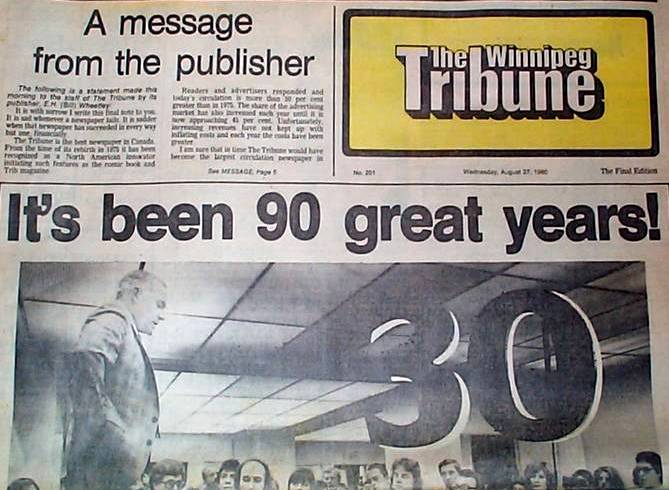
August 27:  The Winnipeg Tribune and the Ottawa Journal publish for the last time. The newspapers have been losing money for some time according to Southam and Thomson, their respective owners.


September 1:  Saskatchewan and Alberta mark their 75th anniversaries as provinces in Confederation. The Diamond Jubilee celebrations have included many festivals and special events including visits from Their Majesties, Queen Elizabeth and Prince Phillip. 


September 2:  Doctors in New Westminster, British Columbia confirm test results that cancer has spread to the lungs of runner Terry Fox. The one-legged athlete was forced to give up his Marathon of Hope in Thunder Bay yesterday, after 143 days on the road.  Terry has raised $2 million for cancer research since he started walking across Canada.  A true hero, Terrence Stanley Fox will die at sunrise on June 28, 1981—a month short of his 23rd birthday.

Prime Minister Trudeau will look on as Queen Elizabeth II brings home the constitution and the Charter of Rights in 1982.

October 2: A frustrated Prime Minister Trudeau tells the press that since he can’t get an agreement with the First Ministers that he will introduce legislation in Parliament and have MPs unilaterally vote in a new constitution with a Charter of Rights.

Churchill Falls, Labrador.

October 6: Newfoundland and Quebec sign the Churchill Falls hydro agreement. It is the largest hydro project in the world and accounts for one percent of the world’s electricity by itself. 


October 23:  No longer just another Toronto newspaper, the first national edition of The Globe & Mail is printed throughout the country using satellite technology. 


October 28: The National Energy Programme comes into existence. The tax will take more than $100 million from the Alberta treasury and be used to equalize gas and oil prices across the country.  Hated by westerners, they will joke that Petro-Canada stands for “Pierre Elliot Trudeau rips off Canada” and thousands of cars will sport bumper stickers that read, “Let those eastern bastards freeze in the dark.”


November 17: Christine Weller of Surrey, BC is abducted. The 12-year old girl’s lifeless body will be found on Christmas day. Police do not know it yet but she is the first victim of serial killer Clifford Olsen who will be arrested on August 12, 1981 and finally confess to his crimes in January of 1982.


November 23:  The Edmonton Eskimos whip the Hamilton Tiger Cats 48 to 10 to win the Grey Cup.


December 11:  The Honourable Jean Lesage is dead of cancer at the age of 68. The politician was an MP in Ottawa for 13 years and Liberal Premier of Quebec from 1960 to 1966. He is credited with many social and political reforms, the creation of both education and cultural affairs ministries as well as ending years of corruption and patronage.

This series of currency was issued in 1973.

December 30: The dollar has lost a lot of ground during the year. One Canadian dollar equals 86 cents in US currency.


December 31:  Dr. Marshall McLuhan is dead. The scholarly professor at the University of Toronto completely changed the world of communications with his profound insights. He was most famous for coining the phrase “global village” and startled the world into a new perception when he said, “The media is the message.”


  Built in Oakville, Ontario, the1980 Mercury Marquis Meteor four-door sedan listed for $7,886. The Grand Marquis with all the trimmings sold for $9,976.