Showing posts with label Jeanne Sauve. Show all posts

Tuesday, August 12, 2014

1922


National Snapshot


From the big scrapbook of time, here’s a look at Canada in 1922-

 The inexpensive Essex is highly popular with Canadians.  Imported from the US, Essex is the lower-priced companion car to Hudson.


January 1: Canadians who enjoy radio listening must now purchase a permit for $1. Regulations are relaxed. People who own radio sets are no longer required to be proficient in Morse Code, no longer need to prove British citizenship or swear an Oath of Secrecy.

January 3: The Royal Mint in Ottawa strikes five-cent coins for the first time. The coins are composed of 100 percent nickel and will be called “nickels”. The first two are ensconced in a plush case and presented to Lord Byng, the Governor General, who is on hand for the occasion.


January 11: The first successful use of insulin in a diabetic person takes place at the Toronto General Hospital. The medical breakthrough will earn Drs. Banting and Best the Nobel Prize in medicine.


January 21: Lincoln Alexander is born in Toronto. He will grow up to become the first African-Canadian elected to the House of Commons in 1968. He will serve as Lieutenant Governor of Ontario from 1985-1991 and then be named Chancellor of the University of Guelph.

March 8: The first session of the 14th Parliament begins. MPs will pass the National Defense Act and create the Canada Wheat Board.


March 20: Jack Kruschen is born in Winnipeg. He will grow up to be star of radio, screen and TV—heard and seen on such popular shows such as Dragnet and Gunsmoke. He will be best remembered for his role as Grandpa Papouli on the sitcom Full House.


March 28:  The Toronto St. Pats do battle with the Vancouver Millionaires and win the Stanley Cup in game number five.


March  -- Rumours swirl that retail giant, the T. Eaton Company, Limited—Canada’s Greatest Store—is on the verge of bankruptcy and will be sold to Sears & Roebuck or Macy’s in the United States.


March 1: The first car from Durant Motors of Canada Limited—a Durant--rolls off the factory line in Leaside (near Toronto). The factory will become the third largest producer of automobiles in the Dominion before going out of business in 1931.


March 11: Gordon McGregor is dead of injuries sustained in a train accident—according to Ford’s publicist. He was VP and General Manager of Ford of Canada.


March 13: Radio station CKCD takes to the air at 8.30 pm in Vancouver. Owned by the Vancouver Province, the station features news and stock reports. It will sign off for good in February of 1940.


March 15: The Vancouver Sun launches a radio station of its own. CJCE is found at 420 kilocycles on the radio dial. It will close down in 1923.


March 16: Every major newspaper in North America has sent reporters to Caledonia Mills, Nova Scotia because people believe a string of fires has been set by ghosts. Dr. Walter Franklin Prince of the American Research Service in New York is the ghostbusting expert who, after studying the phenomenon, reveals that a young girl is setting the fires and creating other mischief on orders of an unknown and invisible power.


March 22: Coal miners in Alberta and British Columbia go on strike. The 12,000 men will stay off the job until August 24, 1923.


March 29: Fire destroys the Basilica of Ste-Anne de Beaupré, 30 kilometres north of Quebec City. Erected in 1658—to honour the patron saint of Quebec—by greateful sailors who survived a shipwreck. The church will be rebuilt. Some 500,000 visitors come each year. Countless devout pilgrims have made the trek to Ste-Anne’s and been rewarded for their faith by being healed of sickness and disease.

CKAC becomes the first Francophone radio station in North America. It is owned by the newspaper, La Presse.
March 31: The Minister of Marine and Fisheries authorizes regular radio broadcasting. He reports that 39 radio stations are already in operation across the Dominion, including CKAC in Montreal and CHCF in Winnipeg.


April 26: Jeanne-Mathilde Benoit is born in Prud’homme, Saskatchewan. She will graduate from the Universite de Paris, marry Maurice Sauve and have a successful career as a journalist at Radio-Canada before becoming a Member of Parliament. PM Trudeau will appoint her Speaker of the House. Known for her unfailing charm and grace, she will serve as our 23rd Governor General from 1984 to 1990. Madame Sauve will die of cancer in 1993.
May 1: The current issue of Canadian Motorist carries an advertisement from GM: “Better cars are being built—and McLaughlin is building them.” Next year the name will be changed to McLaughlin-Buick and continue until it is retired in 1942.

The latest in radios, this Marconi De Luxe Crystal Set Radio Receiver.
May 2: Folks in Calgary can warm up their Marconis and tune in to radio programmes on CFAC. The station is owned by the Calgary Herald.


May 3: Women on Prince Edward Island may now vote and stand for public office as long as they meet the requirements of being good British citizens. That brings to eight the number of provinces where women may vote. Quebec is the lone holdout and women there will have to wait until 1945 for the vote.


May 16: The Newfoundland Government Railway is bleeding money despite a shared agreement between the Dominion government and the Reid Newfoundland Company. The railway is shut down today and the Bullet will not run again until May 23rd.


June: King of the Canadian Cowboys,  Earl Bascom makes the first hornless bronc saddle on his ranch outside of Welling, Alberta.


June 11: The world’s first documentary film opens today in New York City. The subject is the daily lives of the Inuit of Arctic Quebec. The movie is entitled Nanook of the North.


June 22: Folks in Manitoba cam purchase alcohol legally as the legislature opts to end prohibition in favour of a government run liquor board.


July 22: The Canadian Red Cross is on hand with emergency relief in the Saskatchewan towns of Alameda, Frobisher, Lampman, Steelman, and Estevan after an F5 tornado kills four, injures 13 and leaves 42 families reeling in the aftermath of the disaster.


June 30: There are 2,588 licensed radio sets across the Dominion. News, weather, crop and market reports brings the world to previously isolated farmers.


July 29: The skies over the Dominion of Newfoundland have a new voice as radio station VOS takes to the air with the nation's first commercial radio programme.


July 30:  John G. “Jack” McClelland is born in Toronto. He will grow up to work in his father’s publishing company when he is discharged honourably from the Royal Canadian Navy in 1946. He will become president of McClelland & Stewart in 1961 and do much to promote Canadian literature. Authors like Farley Mowat, Morecai Richler and Margaret Atwood become household names under his aggressive marketing programme. McClelland will die in 2004 at the age of 81.


August 2: Alexander Graham Bell dies at the age of 75 at his home in Beinn Bhreagh, Cape Breton Island, Nova Scotia. He invented the telephone nearly half a century earlier in Brantford, Ontario. Dr. Bell will be buried in a hollowed out rock, on the grounds of his summer home.


August 11: Mavis Leslie Young is born in Montreal. She will study journalism, marry and divorce musician John Gallant and leave the world of reporting in 1950 to live in Paris and write. Her stories will appear regularly in New Yorker. Queen’s University will bestow an honourary PhD on the Order of Canada recipient in 1992.


August 17: The coal miners’ strike in Cape Breton turns ugly as troops sent from Halifax to protect the mines are stoned by an angry mob. The area will be declared a police zone by the government in attempt to restore order.


August 24: Rene Levesque is born in Campbellton, New Brunswick. He will become a reporter during World War Two. Entering politics he will become disillusioned with federalism and create the Parti Quebecois—a political party dedicated to making Quebec an independent country. Levesque will leave politics in 1985. He will die of a heart attack two years later at the age of 65.


September 1: Margaret Yvonne Middleton is born in Vancouver, British Columbia. Her friends will call her Peggy. She will move to the United States when she is 15 year old and as Yvonne de Carlo she will become a Broadway and Hollywood star. Yvonne will be best known for her comedic performance as Lily Munster in the 1964 to 1966 American television series The Munsters.


September 3: Salli Terri is born in London, Ontario. She will grow up to become a singer and songwriter, often seen on television. The mezzo-soprano will be part of a choir that sings for Queen Elizabeth’s coronation. In Hollywood she will work in movies, and will be best remembered for being the voice of the cow in the movie Mary Poppins. Salli will die in 1996.


September 15:  Hamilton Tire and Rubber Limited opens in Hamilton, Ontario. The store will change its name to Canadian Tire and grow into a national chain.


September 18: Ford of Canada announces it has sold 1,192 tractors this year. That figure is down substantially from the 3,063 tractors sold last year.


September 18: Prime Minister Mackenzie King tells Britain that Canada will not send troops to fight in Turkey until Parliament votes on the issue. It is the first time that Ottawa exercises its nationalistic muscle, charting a path different from the one set out by London.

October 5: More than 50 people are dead, killed by forest fires in and around Cobalt, Ontario. It is estimated that more than 100 square kilometres of land have been ravished by the worst fires in history.


October 17: Pierre Juneau is born in Montreal. He will grow up to become a broadcaster and be appointed to head the Canadian Radio and Television Commission, be Minister of Communications under PM Pierre Trudeau. During Juneau’s tenure as president of the CBC he will push programming to 95 percent Canadian content and inaugurate CBC Newsworld. The music industry award—the Juno—is named in his honour.


December 1: By order of the legislature, all New Brunswick automobile drivers will no longer drive on the left; the 12,609 registered automobiles must now keep to the right side of the road.

Frank “Pep” Leadlay (left) and Harry Batstone are two of the stars of the unstoppable Queen's teams that will win the next three Grey Cups.

December 2: Queen’s University whips the Edmonton Elks 13 to 1 to take home the Grey Cup.

The 1922 Ford Model T five-window coupe.

December 31: The Ford Motor Company of Canada Limited reports it has 3,427 employees on its payroll.


December 31:  Our vast, sprawling nation grows closer as the newly formed Radio Branch of the Department of Naval Service has issued 58 operation licenses to private commercial broadcasters from Sydney to Victoria.

Workers at GM Canada in Oshawa, Ontario build 16,878 Chevrolet motorcars in 1922.


Monday, March 25, 2013

1980

From the big scrapbook of time, here’s a look at Canada in 1980-
The 1980 Buick Skylark is imported from the USA. The four-door sedan weighs in at 1 121 kilos (2,473 pounds) and lists for $6,642.

January 1: Police in Chapais, Quebec talk about the fire that started last night at the New Year’s Eve party. Preliminary investigation shows the inferno killed 42 people and sent another 50 to hospital was “definitely of criminal origin.”  Many witnesses at the nightclub watched in horror as a young man set the dry fir boughs on fire. The suspect is in custody. 


January 2: The dollar is strong. CAD$1.06 equals USD$1.


January 21: The federal government deports three staffers from the Soviet Union’s embassy in Ottawa after the RCMP accuses them of spying on Canada.

US President Ronald Regan (centre) will award Ken Taylor (right) the US Congressional Gold Medal. He is the only foreigner to ever receive the honour.

January 28: Six American diplomats escape from Iran because they have phony Canadian passports issued by Ken Taylor, our Ambassador to Iran. The Americans were employees of the US State Department who hid out at the Canadian Embassy in Tehran for three months after Iranian revolutionaries overran the American Embassy and took 66 diplomats hostage.  


February 8: The Conservative government Joe Clark has fallen. The PM is on the campaign trail. He tells people in Winnipeg that immigration law will be changed so that people who wish to come to Canada must apply for Landed Immigrant Status in their country of origin.


February 18: The electorate has spoken. Prime Minister Joe Clark and his Tories go down to defeat. Pierre Trudeau and his Grits have won a majority government with 148 seats. Though the Liberals have 48 percent of the popular vote, they hold only two seats west of Ontario. The Conservatives are reduced to 101 seats and the NDP has 32 seats in the next House of Commons. 

The green chair next to the Canada flag is the Speaker's Chair.

February 29: Prime Minister Trudeau appoints Jeanne Sauvé to serve as Speaker of the House. The reporter-turned-politician from Saskatchewan is the first woman to be Speaker. Her primary tasks are to conduct House business and manage the staff.


March 3: At a ceremony in Rideau Hall, Pierre Elliot Trudeau is sworn is as Prime Minister of Canada.
Jay Silverheels (left) as Tonto and Clayton Moore (right) as The Lone Ranger.

March 5: Actor Jay Silverheels is dead of pneumonia in Hollywood at the age of 62.  The Mohawk Indian hailed from Brantford, Ontario and was born Harold J. Smith. The Hollywood star played in many movies but is best remembered for being Tonto in the popular radio and TV series, The Lone Ranger.
Quebec's National Assembly is designed in the Second Empire style. It has been home to elected members since 1886.

March 20: In Quebec City, legislators approve the wording for the upcoming referendum question that will determine the province’s future. The Parti Quebecois government hopes to lead Quebec out of Confederation and into nationhood.

March 27: The Toronto Stock Exchange experiences its biggest loss since 1940—after the Hunt brothers fail to corner the silver market.

Murder by Decree tells the story of Jack the Ripper, a notorious serial killer.

March 20: Beloved CBC-TV star Bruno Gerussi hosts the first ever Genie Awards.  Best Motion Picture is The Changling. Christopher Plummer takes home a Genie for Best Actor, starring in Murder by Decree and Kate Lynch is awarded a Best Actress Genie for her role in Meatballs. Gordon Pinsent receives a Supporting Actor Genie for his role in Klondike Fever and Genevieve Bujold gets a Supporting Actress Genie for her role in Murder by Decree.


April 2: Burton Cummings hosts the Juno Awards held at the Harbour Castle Hilton in Toronto. He wins a Juno for best male artist. Anne Murray wins a Juno for being best female vocalist, another for album of the year—New Kind of Feeling—and a third for her hit single of the year—I Just Fall in Love Again.

April 9:  Ottawa will spend $2.7 billion to purchase 137 F-18 Hornet fighter craft for the Canadian Armed Forces.

April 14: It’s Oscar night and the National Film Board wins a golden statuette for its animated film submission, Chaque Enfant/Every Child. This the NFB's sixth Oscar since it was founded in 1939. The NFB reports to Parliament through the Federal Minister of Canadian Heritage.


April 12: A young man dips his artificial leg into the Atlantic Ocean as he embarks upon an ambitious attempt to cross Canada on foot. He starts his journey today in St. John’s, Newfoundland. Hoping to raise money for cancer research, Terry Fox will die trying and inspire millions with his heroic Marathon of Hope.
Countries in grey will boycott the Summer Olympics. Countries coloured green have participated in previous games, countries coloured in blue will participate for the first time, light green countries have competed under the Olympic flag.

April 22:  External Affairs Minister Mark MacGuigan announces that Canada will not participate in the 1980 Summer Olympics to be held in Moscow. This measure is meant to protest the Soviet Union’s invasion and occupation of Afghanistan.


April 29: Telecommunications giant Bell Canada marks its 100th anniversary.


April 30: NHL legend Gordie Howe announces he will hang up his skates for good. The Hartford Whaler is 52 years old and holds records for most games played, most goals, most points and most assists.
The Plymouth Caravelle is built in Windsor, Ontario.

May 10: Ottawa announces it will give troubled Chrysler Canada $200 million in loan guarantees. Queen’s Park will put another $10 million in the pot to keep the 54-year old Windsor, Ontario automaker afloat. The company will pay back the money in two years but will find itself in more hot water in 2009.


May 22: In an emotional day at the polls, Quebeckers say “oui!” to Canada as 60 percent of voters reject independence. Regarding the victory, Prime Minister Trudeau somberly tells reporters, “We have all lost a little in this referendum. If you take account of the broken friendships, the strained family relationships, the hurt pride, there is no one among us who has not suffered some wound which we must try to heal in the days and weeks to come.”


May 23: Canada’s Wonderland opens its doors for the first time. Superhero Wayne Gretzky raises the maple leaf flag as 12,000 guests watch. Located 30 kilometres north of Toronto, the $120-million theme park is 1.3-kilometres square, it is filled with 48 thrill rides—including 15 roller coasters--and 200 other premier attractions. Wonderland will amuse more than 3 million people a season in the 21st Century.


May 24:  The New York Islanders skate to the Stanley Cup, beating the Philadelphia Flyers in four games to two.

June 16: Country singer Bob Nolan is dead of a heart attack. He is 72 years of age. He is best remembered as of the founders of the hit cowboy singing group, Sons of the Pioneers. His 1941 recording of Cool Water and Tumblin' Tumbleweeds earned them a Grammy. The Winnipeg native will be inducted posthumously into the Canadian Country Music Hall of Fame in 1993 and into the Canadian Songwriters Hall of Fame in 2005.


June 27:  Parliament declares O Canada to be our national anthem and Governor General Ed Schreyer makes a special royal proclamation as well. To mark its passage in the House of Commons, all MPs stand and sang the anthem. God Save the Queen is now Canada's royal anthem.

The new flag was designed by Christopher Pratt.

June 24: Newfoundland and Labrador’s new flag is hoisted officially for the first time. The new flag replaces the Union Jack, flown since the 1500s.


July 21: Newfoundland’s fishing industry is paralyzed by layoffs, labour disputes and lockouts, leaving 35,000 fishery workers high and dry.

July 19: The 22nd Summer Olympics open in Moscow. Canada and 59 other nations boycott the games to protest the USSR’s 1979 invasion of Afghanistan.

July 30: To mark the province's 75th anniversary, Alberta’s royal coat of arms is augmented with a crest and supporters by order of Her Majesty, Queen Elizabeth II.

August 1: Alberta and Saskatchewan increase the price of a barrel of crude oil by $2. A 45-gallon drum of Canadian sweet crude will now fetch $16.75—and that is $20 less than other countries. The hike will cost consumers 1.5 cents a litre more when they pull into Irving, Olco, Beaver or Husky stations.

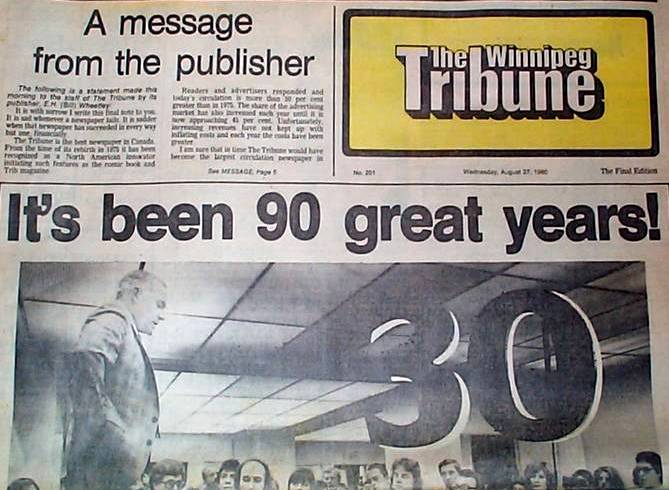
August 27:  The Winnipeg Tribune and the Ottawa Journal publish for the last time. The newspapers have been losing money for some time according to Southam and Thomson, their respective owners.


September 1:  Saskatchewan and Alberta mark their 75th anniversaries as provinces in Confederation. The Diamond Jubilee celebrations have included many festivals and special events including visits from Their Majesties, Queen Elizabeth and Prince Phillip. 


September 2:  Doctors in New Westminster, British Columbia confirm test results that cancer has spread to the lungs of runner Terry Fox. The one-legged athlete was forced to give up his Marathon of Hope in Thunder Bay yesterday, after 143 days on the road.  Terry has raised $2 million for cancer research since he started walking across Canada.  A true hero, Terrence Stanley Fox will die at sunrise on June 28, 1981—a month short of his 23rd birthday.

Prime Minister Trudeau will look on as Queen Elizabeth II brings home the constitution and the Charter of Rights in 1982.

October 2: A frustrated Prime Minister Trudeau tells the press that since he can’t get an agreement with the First Ministers that he will introduce legislation in Parliament and have MPs unilaterally vote in a new constitution with a Charter of Rights.

Churchill Falls, Labrador.

October 6: Newfoundland and Quebec sign the Churchill Falls hydro agreement. It is the largest hydro project in the world and accounts for one percent of the world’s electricity by itself. 


October 23:  No longer just another Toronto newspaper, the first national edition of The Globe & Mail is printed throughout the country using satellite technology. 


October 28: The National Energy Programme comes into existence. The tax will take more than $100 million from the Alberta treasury and be used to equalize gas and oil prices across the country.  Hated by westerners, they will joke that Petro-Canada stands for “Pierre Elliot Trudeau rips off Canada” and thousands of cars will sport bumper stickers that read, “Let those eastern bastards freeze in the dark.”


November 17: Christine Weller of Surrey, BC is abducted. The 12-year old girl’s lifeless body will be found on Christmas day. Police do not know it yet but she is the first victim of serial killer Clifford Olsen who will be arrested on August 12, 1981 and finally confess to his crimes in January of 1982.


November 23:  The Edmonton Eskimos whip the Hamilton Tiger Cats 48 to 10 to win the Grey Cup.


December 11:  The Honourable Jean Lesage is dead of cancer at the age of 68. The politician was an MP in Ottawa for 13 years and Liberal Premier of Quebec from 1960 to 1966. He is credited with many social and political reforms, the creation of both education and cultural affairs ministries as well as ending years of corruption and patronage.

This series of currency was issued in 1973.

December 30: The dollar has lost a lot of ground during the year. One Canadian dollar equals 86 cents in US currency.


December 31:  Dr. Marshall McLuhan is dead. The scholarly professor at the University of Toronto completely changed the world of communications with his profound insights. He was most famous for coining the phrase “global village” and startled the world into a new perception when he said, “The media is the message.”


  Built in Oakville, Ontario, the1980 Mercury Marquis Meteor four-door sedan listed for $7,886. The Grand Marquis with all the trimmings sold for $9,976.