Showing posts with label Charlotte Whitten. Show all posts

Tuesday, February 4, 2014

1951


From the big scrapbook of time, here’s a look at Canada in 1951-

 Workers at the Studebaker Corporation of Canada Limited, in Hamilton, Ontario will build 11,180 Champions, 1,853 Commanders and 1,824 trucks during the model year. Studebaker is the eighth best selling automobile in the Dominion.

January 17: Folks in Colchester, Nova Scotia will no longer be paid $1 for the nose of each porcupine brought in by hunters. Last year the officials paid out $34,000 to rid the county of the destructive critters.

January 28: The Labour Progressive Party wraps its political convention in Toronto. The RCMP is keeping a close eye on this organization; the party is nothing more than thinly disguised Communism.


The Duplessis Bridge connects Trois-Rivieres with Quebec City.
February 1: The three-year old Duplessis Bridge spanning the St. Lawrence and St. Maurice rivers at Trois-Rivieres, Quebec collapses at 2.55 in the morning, killing three workers. A fourth will die later. Witnesses all report a blinding light followed by an earthquake-like rumble.  Sabotage by Communists is suspected but an inquest will reveal shoddy workmanship and substandard steel.

The CBC's International Service broadcasts from this building from 1944 to 2012.
February 4: Radio Canada begins regular shortwave service in the Russian language. The powerful transmitter in Sackville, New Brunswick will transmit programs of freedom and hope to millions of Soviet citizens who live behind the Iron Curtain.

February 16: Although it is still hotly debated issue, the fluoride committee in Brantford, Ontario notes that since the community added the substance to the town’s drinking water, tooth decay among children has dropped considerably.

February 24: Helen Shaver is born in St. Thomas, Ontario. She will grow up to be an actress appearing in television and movies. In 2003 she will star in the crime thriller The Keeper. She will earn a star on Canada's Walk of Fame in 2004. A Gemini and Emmy will be bestowed upon her for her directing and producing skills.

March: Folks who warm up their Northern Electrics and tune to the CBC in Newfoundland and Labrador hear a new program, The Fisherman’s Broadcast. The name will change to the Fisheries Broadcast in the 1980s but “The Broadcast” is part of daily life and will still be going strong in the 21st Century, one of the longest-running shows in radio broadcast history.

This monument in Busan, South Korea honours the 516  brave Canadians who died in the Korean War.
March 2: The Department of National Defense releases the names of the first six Canadian soldiers to die in combat in the Korean conflict.

March 8: As of today, women who hold the same jobs as men in Ontario are entitled to equal pay. Employers who break the law will be fined $100.

March 9: MPs vote to approve incorporation of TransCanada Pipelines. The company will construct a 5,000 kilometre-long pipeline to bring natural gas from Alberta to Quebec. The cost to taxpayers is estimated to cost $80 million.

April 8: Sara Botsford is born in the tiny mining community of Dobie, Ontario. She will grow up to be a soap opera star as well as playing roles in many TV shows and movies including Trudeau, The Fog and Eulogy.


April 21: Every game goes into overtime but Toronto whips Montreal four games to one for the biggest prize in hockey, Lord Stanley’s Cup.

April 22: Canadian soldiers hold back the enemy in the three-day Battle of Kapyong. The fighting is fierce, Chinese soldiers outnumber Princess Patricia’s Light Infantry eight to one. Ten soldiers are dead and another 23 wounded but their brave defense on Hill 667 keeps the South Korean capital of Seoul from falling into enemy hands.

April 24: The ever-deepening Cold War demands big changes in the armed forces. The Minister of Defense announces that it will recruit women this for selected military positions. Although recruited during World War Two, the program for female recruitment was cancelled in 1946. Some 5,000 women serve during the Korean Conflict--60 are frontline nurses in Korea and another 40 are Flight Nurses accompanying wounded soldiers from Japanese hospitals to Canada.

May 4: The 27th Canadian Infantry Brigade is formed. It will be deployed to Europe where it will serve with other NATO forces.

June -- The Indian Act is overhauled for the first time in more than a century. The centrepiece of the new legislation is still the assimilation of natives into mainstream culture.

June 1: The Dominion Bureau of Statistics says there are 14,009,429 of us in the country spread out coast-to-coast-to-coast.

June 1: The Massey Royal Commission on the Arts is released. It outlines the current state of Canadian culture and strongly urges that Ottawa make grants available to artists through a mechanism to be called the Canada Council.

The Royal Vic opened its doors in 1893. It has been associated with McGill University as a teaching hospital since 1920.
June 21: The first folks in the country to watch colour television are the 2,000 doctors attending a medical convention in Montreal. They view from the Hotel Mount Royal as abdominal surgery is performed—live--at the Royal Victoria Hospital.

July 1: Canada turns 84 years old. Dominion Day is marked by 14 million of us with picnics, parades and fireworks. The country has a little present for Prime Minister St. Laurent, an official residence. Located at 24 Sussex Drive, the gracious three-storey, 34-room mansion will be home to future Prime Ministers.

July 10: Parliament declares war with Germany to be officially over. A formal peace pact is signed.

September 20: Guy Lafleur is born in Thurso, Quebec. He will be passionate about hockey and his thrilling NHL career will span more than 30 years.

October 1: Charlotte Whitton is acclaimed as Mayor of Ottawa. She steps into the shoes of the recently deceased Mayor, His Worship, Grenville Goodman. The 1917 graduate of Queen’s University is the first woman in the nation to lead a large urban centre. Whitton will be elected to the Mayor’s office four times.

October 27: In cooperation with Atomic Energy Canada Limited, cobalt therapy is tested for the first time, anywhere in the world, as part of cancer treatments at the Victoria Hospital in London, Ontario.

November 11: Princess Elizabeth is in Newfoundland this Remembrance Day. She says au revoir to Canadians at the end of a whirlwind, five-week tour of the country that took the Princess and the Duke of Edinburgh to every province.

Celie Franca will lead the National Ballet until 1975.
November 12: The National Ballet of Canada debuts at the Eaton Auditorium in Toronto. The programme includes Les Sylphides and Polovtsian Dances from Prince Igor.

Caskets of fallen soldiers in Korea are draped in Canada's national flag, the Red Ensign.
November 22: The conflict in Korea escalates as the Van Doos are attacked by the Chinese in rain and freezing weather. The Battle of Un-Gol will rage for 96 hours, non-stop. Fighting for freedom from Communism, our soldiers will stubbornly hang onto their position between Hills 210 and 355.

November 24: The Ottawa Rough Riders whip the Saskatchewan Roughriders 21 to 14 at Varsity Stadium in Toronto to win the 39th Grey Cup championship..

December: Natives in British Columbia may now legally drink alcohol in bars and clubs.

December 12: The St. Lawrence Seaway Authority comes into existence. Marine traffic will start using Highway H2O in eight years.
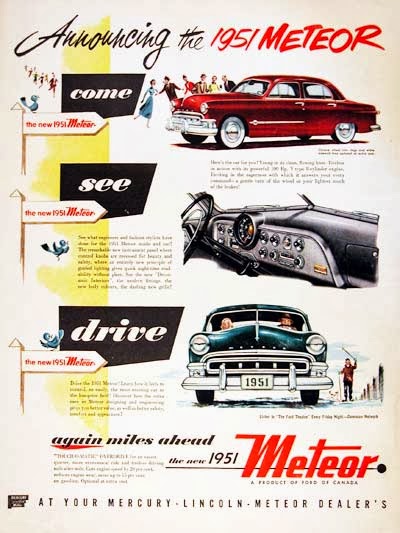
December 31: The Top Ten selling automobiles in Canada this year in order are: Chevrolet, Pontiac, Ford, Meteor, Dodge, Plymouth, Buick, Studebaker, Oldsmobile and British Ford.


Wednesday, May 29, 2013

1975


From the big scrapbook of time, here’s a look at Canada in 1975--


January 1: All domestically sold products must now be labeled in both Imperial and Metric measure. It will be confusing at first but we need to practise.  Canada will officially adopt the Metric System a year from today.


January 25:  Her Worship, Charlotte Whitten is dead at the age of 79. The colourful, four-term mayor of the nation’s capital was famous for her quip, “Whatever women do they must do twice as well as men to be thought half as good.”


February 14: Fans in Winnipeg go wild as hockey star Bobby Hull ties Rocket Richard’s 30-year old record of scoring 50 goals in 50 games. Hull is playing for the Jets this season.


February 25: American Motors introduces the Pacer. Folks snap up 7,381 of the small, wide cars during the calendar year. Happy officials at American Motors Canada Limited record sales of 36,385 passenger cars and 5,196 Jeep trucks and SUVs during the year.


March 1: Music industry icons Anne Murray and Oscar Peterson win Grammys tonight.

March 4: Today’s sitting of the House of Commons is recorded by CBC Television crews.  It is the first time that cameras have ever been allowed into the House.


March 12: The RCMP charge 14 individuals and more than a dozen companies with conspiracy to defraud the government of $4 in what will come to be known as the Hamilton Harbour dredging scandal.

March 17: Gina Holden is born in Smithers, British Columbia. She will grow up to become a model—become famous in Japan—before returning to Canada to begin an acting career. She will appear in TV shows including Flash Gordon, Blood Ties, Life Unexpected and Harper’s Island.

March 24: Members of Parliament vote to make the beaver our national symbol. 
Seasons in the Sun will hit the top of the music charts in the US and the UK.

March 24: Paul Anka hosts the Juno Awards, televised for the first time, from the CNE  in Toronto. Anne Murray and Gordon Lightfoot win Junos for male and female vocalists of the year. Bachman-Turner Overdrive win best album Juno, Not Fragile and best single Juno goes to Terry Jacks for Seasons in the Sun.

March 25: Thunder Bay is snowed in. Environment Canada reports the city was hit with 102 centimetres of the white stuff, making it the biggest one-day snowfall on record.

March 26: It is 18 months in prison for Dr. Henry Morgantaler. The avowed abortion-rights doctor tells the press he has no regrets; that he is on the side of right. The Supreme Court has ruled otherwise.

April 1: Environment Canada begins reporting temperatures in Metric. To translate, double the Celsius temperature and add 32 to find the old Fahrenheit-degree equivalent.

The CN Tower will change the skyline of Toronto for years to come.

April 2: The last section of the CN Tower is lifted into place by a helicopter. The world’s tallest freestanding structure is owned by Canadian National Railways and cost $44 million. It is 533.33 metres tall and used 145 tonnes of concrete but it won’t open officially until October 1 of next year. When it does, it will attract 2 million visitors a year. Those who ride to the top in the glass elevators will hear the operator say, “Thank you for flying CN.”

Osgoode Hall in downtown Toronto is home to the Ontario Court of Appeals.

April 14: The Ontario Court of Appeal hands down a ruling that divorced women may legally pursue their ex-husbands for damages.

There will be more than 200,000 Vietnamese refugees in years to come. Half of the 'boat people' will find new homes in Canada.

May 1:  As a humanitarian gesture, Canada will accept 3,000 South Vietnamese refugees who have lost everything in a civil war and escaped the country in rickety boats.


May 2: The first shovel goes into the ground as construction of the Point Lepreau nuclear power station gets underway. The cost of the mega-project will be $1.3 billion and the facility will provide 30 percent of New Brunswick's electricity requirements when it opens in 1983.

May 17: Ten women begin training at the Ontario Police College in Aylmer, Ontario. When they graduate they will be the first female constables in the Ontario Provincial Police force. 


May 24: It is the birthday of Marc Gagnon. Born today in Chicoutimi, Quebec and faster than greased lightening on a pair of skates, he will grow up to earn more Olympic medals at Winter Games than any other Canadian athlete.
Lord Stanley's Cup, raised in victory by Bernie Parent and Bobby Clark.

May 27: The Stanley Cup belongs to the Philadelphia Flyers as they whip the Buffalo Sabres, four games to two. Unusually hot weather created a fog and the match will come to be known as The Fog Game.  It's the first time the Sabres make the finals and every one of the Flyers is Canadian.

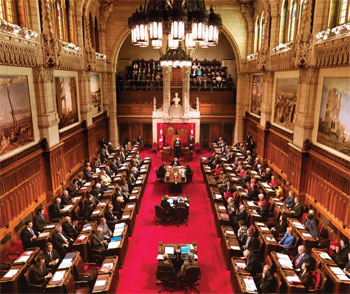
Senators are appointed by the government of the day, not elected.
May 30: The Yukon and the Northwest Territories now have seats in the Senate. That brings to 104, the number of Senators who sit in the Red Chamber, the house of sober, second thought.
Prince Edward Island is 'the Garden in the Gulf'. The province's most famous resident is Anne of Green Gables, a character created by author Lucy Maude Montgomery.
June 26: The Supreme Court of Canada rules in favour of Prince Edward Island’s law that forbids non-residents from owning more than four hectares of land.

June 27: Prime Minister Trudeau is on hand in L’Anse aux Meadows, Newfoundland to cut the ribbon and officially open the country’s newest National Park. The 8,000-hectare preserve contains the oldest known settlement in the New World, one belonging to long-ago Viking pioneers.


June 28: Jeff Geddis is born in Thunder Bay. He will grow up to be an actor, starring as Mike Nesmith in the VH1 Daytime Believers: The Monkees’ Story; Andrew Shepherd in the Family Channel series, The Latest Buzz and as Matt Scott on the CBC comedy Sophie.


July 7: The New Democrats elect a university professor to lead their party. Ed Broadbent wins on the fourth ballot, beating out Lorne Nystrom, John Harney and his most formidable opponent, Rosemary Brown. Broadbent will lead the NDP for 15 years before retiring from politics to become director of the International Centre for Human Rights and Democratic Development. In 2004 he will come out of retirement to run for Parliament again.

Springhill, Nova Scotia is the hometown of superstar Anne Murray.

July 20: A raging fire sweeps through the downtown business core of Springhill, Nova Scotia, destroying 25 buildings. Damage is estimated at $3 million.

These USSR stamps honour the Soviet fishing fleet.

July 23: Fishing vessels belonging to the Soviet Union are banned from docking at Canadian ports of call. This drastic measure is taken because the Soviet Atlantic fishing fleet continually ignores set catch quotas. They take what they want. The super trawlers are floating factories. Soon, there won’t be any cod stocks left for anyone. 

July 30: There ís a new kid on the street corner as the federal government orders the creation of Petro-Canada. The Crown corporation will protect national interests. It makes Ottawa a big player in the oil patch; its coast-to-coast-to-coast retail chain is made up from the purchase of Belgium’s Petro-Fina and the American Pacific 66 chains.


August 1: Representatives of Canada are in Finland to sign the Helsinki Accord. The international agreement respects the rights of nations at the same time holding sacred individual human rights. The historic document is signed by delegates from 35 countries in all.


September 1: The CBC purchases CKLW-TV, Channel 9, in Windsor, Ontario. The station’s new call letters are CBET. 
Mirabel International will lose favour as an airport because there is no light, rapid transit to and from Montreal.

October 4: The nation’s newest airport opens in Mirabel, Quebec. The $500 million facility is intended to be a super airport serving both Ottawa and Montreal. Critics call it a white elephant. By 2004 it will only serve cargo planes. 
The SS Edmund Fitzgerald in the Detroit River.

November 10: The SS Edmond Fitzgerald sinks in a violent storm on Lake Superior with all 29 hands on board. The 222-metre long ship was carrying a load of taconite. Folk singer Gordon Lightfoot will immortalize the marine disaster in his ballad The Wreck of the Edmond Fitzgerald.


November 11: The Cree and Inuit of Northern Quebec sign the James Bay and Northern Quebec Agreement. This treaty gives them sovereignty over a portion of Quebec that is the size of Texas.


November 18: Buckle up or pay a big fine in Ontario. The wearing of safety belts in moving automobiles becomes law today. A dramatic public service announcement put out by the provincial Ministry of Transport is aired around the province. It shows a pumpkin flying through the air and smashing into bits on a highway. The question is asked, “If you’re not wearing your seatbelt, what’s holding you back?”


November 18: Ottawa will bail out floundering Canadair. The company that started as Vickers in 1944 will now become a new Crown Corporation. The St. Laurent, Quebec-based manufacturer will be restructured and will develop an Aerospace Division. When profitable, it will be sold to Bombardier in 1986.

November 23: Edmonton squeaks past the Alouettes 9 to 8 on the last play of the game to win the Grey Cup. It is the first time that Calgary has ever hosted a Grey Cup game. This win is sweet revenge for the Eskimos who lost the Grey Cup to Montreal last year.

Canada Post piggy bank.

December 2: By a narrow margin, posties vote to return to work after a six-week strike. The Union of Postal Workers demanded protection from jobs being replaced by machines that can read the new Postal Code, a 40-hour workweek and a $1.70 per hour wage increase over three years. They get the raise but the union position was weakened because more than 2,000 workers crossed picket lines and went to work anyway.

December 3: In a bid to deal with runaway inflation, Ottawa establishes the Anti-Inflation Board to be headed by Jean-Luc Pepin. Voters are outraged; Robert Stanfield’s Tories had announced they would set up such a commission to control prices and wages during last year’s election, which gave the Grits a minority government. 

Bricklin is a fibreglass sports car built in Saint John, New Brunswick.

December 31: The Top Ten selling automobiles for the calendar year are Chevrolet (full size); Ford (full-size); Plymouth Valiant; Chevrolet Malibu; Dodge Dart; Oldsmobile Cutlass; Toyota; Pontiac (full-size); Pontiac LeMans and Chevroletís Nova. At the bottom of the list is Dodge Challenger and Plymouth Barracuda with 13 sales; Bricklin with 22 sales; clearance of last yearís AMC Javelin and Ambassador with 97 sales; the Pontiac Sunbird with 120 sales; Dodge Aspen with 241 sales; Plymouth Volare with 266 sales; Jaguar with 340 sales; Imperial with 369 sales and the Pontiac Acadian with 708 sales.