Showing posts with label James Bay Agreement. Show all posts

Wednesday, June 12, 2013

1974


From the big scrapbook of time, here’s a look at Canada in 1974--

Only 1,695 AMC Ambassadors are sold domestically this year. The nameplate that first appeared in 1927 will not return for 1975.

 January 1: The Canadian Stock Exchange and the Montreal Stock Exchange merge.

January 6: Move over CBC and CTV, you’ve got company. The Global Television Network hits the airwaves. At first, the nation’s third English-language TV network is seen only in Ontario but the Calgary-based broadcaster will spread across the country, becoming truly national when it starts broadcasting from Quebec City in 1997. Newfoundlanders still won’t have a Global affiliate in 2008 but can see many of the network’s programmes on NTV.


January 7: Bora Laskin is sworn in as Chief Justice of the Supreme Court. He will hold the position until his death in 1984.

The Right Honourable Jules Leger and Queen Elizabeth II.
January 14: Jules Leger is sworn in as Canada's 21st Governor General. The career diplomat has been our Ambassador to Mexico, Italy, France and Belgium. As Vice-Regal, he will represent Elizabeth II, Queen of Canada.

Huge trucks haul loads oil-rich tar sand to refineries.
January 14: The Alberta government announces it will spend $100 million over the next five years to develop the technology needed to extract crude oil from the Alberta Tar Sands.

Founded in Buctouche, New Brunswick in 1924, Irving Oil Limited will become a giant in the industry, retailing gasoline in the four Atlantic Provinces, Quebec, Ontario and the New England States.

January 23: The First Ministers agree that the price freeze on oil will be lifted in April but the price of gasoline and heating oil will be uniform throughout the country. The deal is complicated and leaves many Albertans angry. Lots of cars in Wild Rose Country are plastered with bumper stickers that read, “Let those eastern bastards freeze in the dark.”

February 21: Ottawa tightens up immigration rules. Folks hopeful of living in Canada can lo longer arrive in the country without a firm job offer in hand.

February 21: Hockey great and coffee shop entrepeneur Tim Horton is dead at the age of 44, the result of an accident on the QEW (Queen Elizabeth Way). His new Pantera crashes at 160 kilometres an hour. He leaves to mourn a wife and four children. The autopsy will reveal that alcohol and painkillers played a role in his death.


March 6: Federal Minister of Indian and Northern Affairs, Jean Chretien, tells the press that there will be a two-year moratorium on drilling for oil in the Beaufort Sea. Ottawa is concerned about environmental safety of the fragile Arctic eco-enironment and it is noted there is no technology in existence to clean up after a disaster, should one occur.


March 18: The first Indian reserve in the Northwest Territories is created. The Dene territory is located near the town of Hay River.

March 19: All children eight years of age and under are now guaranteed free dental service in Quebec.

The Juno statuette looked like this from 1970-1974.

March 25: George Wilson hosts the Juno Awards, held in the Centennial Ballroom at The Inn on the Park in Toronto. Anne Murray wins a Juno for best female vocalist. Terry Jacks wins his Juno as best male vocalist.

The Pacific 66 stations in the four western provinces will become part of Petro-Canada in 1975.
March 27: The price of a barrel of domestically-produced crude oil will rise from $4 to $6.50 and that will make motorists' wallets a little lighter.

April 1: The CBC is told to cut commercials from all radio and TV broadcasts within the next five years. By January of 1975, half of all TV programmes aired in prime time must be Canadian in content.
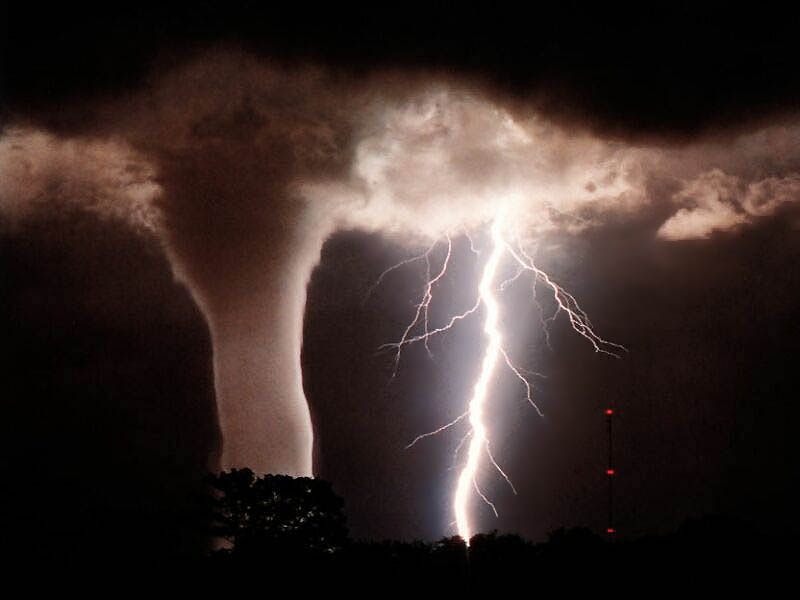
April 3: An F3-strength tornado rips through Windsor, Ontario at 8.09 pm EST, killing eight and injuring 12 at the Windsor Curling Club. A portion of the roof at Chrysler’s Plant Three is torn away but production is not affected. A total of nine are killed and more than 20 people injured in Essex County by the deadly twister.

Uranium Mine (1938), is one A. Y. Jackson's most famous paintings.
April 5: Artist A. Y. Jackson is dead at the age of 91. He is the last of the famed Group of Seven, artists who defined the soul of Canadian art. Jackson will be buried on the grounds of the McMichael Canadian Collection, near others in his circle, in Kleinburg, Ontario.

April 15:A group of nine Quebec women go wild when they learn they have won the $1 million grand prize in the very first Canada Olympic Lottery ever to be drawn.

April 17: Saskatchewan's health plan now covers the cost of prescriptions for all residents.


The Right Honourable Pierre Trudeau is leader of the Liberal Party and Prime Minister.
May 8: The House of Commons passes a non-confidence motion on the Liberal government’s budget tonight. It is the first time in history a sitting government has fallen as the result of a budget debate. The Grits have been sitting as a minority for nearly two years.


May 19: The government has fallen and so do the mighty Boston Bruins as the Philadelphia Flyers skate to the Stanley Cup in six games.

The plutonium for India's Smiling Buddha atomic bomb came from Canada. The federal government was assured the plutonium would be used to power a nuclear reactor to provide hydro-electric power for people.

May 21: Ottawa cancels orders all future orders of nuclear equipment to India after that Southeast Asian country exploded an 8-kilotonne nuclear device.


May 23: New Brunswick becomes the first officially bilingual province.  From now on, all laws in the Picture Province will be drafted in both French and English and citizens will have the right to be served in the official language of their choice.

DeHaviland designed the DHC-6 Twin Otter, affectionately nicknamed "the tractor of the Arctic." Built from 1966 to 1998, this one carries the colours of Air Inuit, serving the people of Nunavik, a.k.a. Nouveau-Quebec.
May 27: Ottawa announces its intention to buy foreign-owned DeHaviland Aircraft of Toronto and Canadair of Montreal and make them into profitable Canadian concerns.

Alanis' first album, Jagged Little Pill, will win six Junos and three Grammys in 1996.
June 1: Twins Alanis and Wade Morisette are born in Ottawa to schoolteacher parents. Alanis will grow up to be a singer and songwriter with a slew of Junos and Grammy Awards that attest to her singing ability.

This Royal Hudson steam locomotive had the honour of carrying King George VI and Queen Elizabeth across Canada during the 1939 Royal Visit.
June 21:  Canadian Pacific Railroad Royal Hudson steam engine Number 2860 was retired from service in 1959 but it will now have a new life as an excursion train. The Royal Hudson will make the scenic trip from Vancouver to Squamish. Retired for a second time in 1999, the locomotive will be refurbished and returned to special service in 2009, to the delight of all who love the majesty of steam-powered locomotives.

June 29: Ballet superstar Mikhail Baryshnikov defects from the Soviet Union when the Bolshoi Ballet tour arrives in Toronto.

Canada Day: More than 250 icebergs have been sighted off the east coast of Newfoundland. They come from Greenland. The average speed of these majestic mountains of ice is 17 kilometres a day.

The Honourable Ralph Steinhaur is Alberta's 10th Lieutenant Governor.
July 2: Ralph Steinhauer becomes the first Native Canadian to be named Lieutenant Governor when he is appointed to serve as the Queen’s representative in Alberta. His heritage is Cree.

Canada's new ocean frontiers cover 1.84 million square hectares (7.1 million square miles).
July 4: Canada will extend its coastal jurisdiction from 19 kilometres (12 miles) to 331 kilometres (200 miles) offshore to include an ‘economic zone,’ says Federal Fisheries Minister, Jack Davis.


July 8: The Liberals have been in the minority government doghouse long enough. Sitting at the CBC election desk, senior newsreader Knowlton Nash calls a majority government for the Grits. Final count will be 139 seats for Trudeau’s Liberals, 96 seats for Robert Stanfield’s Tories, 16 seats for David Lewis’ New Democrats, 12 seats for the Creditistes and Leonard Jones, a vociferously anti-Francophone lawyer from Moncton, will sit as an independent in the House of Commons.

July 30: As of today, French is the official language in Quebec. The vote in favour of Bill 33 in the National Assembly is 92 to 10. 

August 9: Nine Canadian UN Peacekeepers are killed in Syria when their unarmed DeHavilland Buffalo transport plane is shot out of the sky by three Syrian missiles.


August 14: Natasha Henstridge is born in Springdale, Newfoundland. She will grow up in a mobile home park in Fort McMurray, Alberta and become a supermodel by age 15, appearing on the cover of Cosmopolitan. She will give up modeling for the Hollywood and appear in such flicks as Species and The Whole Nine Yards.


August 15: The Toronto Zoo opens to the public. Sprawling over 287 hectrares it will be home to 5,000 animals who will be seen by 1.2 million visitors annually.

Cindy Nicholas will graduate from the University of Toronto and the University of Windsor before being elected in1987 to serve as a Liberal MPP at Queen's Park.

August 16: Cindy Nicholas climbs out of Lake Ontario to the sound of wild cheers and boat horns. The 16-year old native of Scarborough, Ontario has set a record for swimming the 52-kilometre lake in 15 hours and 18 minutes.


September 17: The Horsemen have something new to deal with as the first four women are sworn in as officers of the Royal Canadian Mounted Police. A female Mountie will earn $10,794 a year and yes; she will have to get her man.

David Lewis, Ed Broadbent and Stanley Knowles.

September: The New Democratic Party has chosen a new leader at its convention. Ed Broadbent is a teacher. He replaces David Lewis, who lost his seat in the recent federal election.

September 26: Support staff at the University of Saskatchewan walk off the job for the first time since they were organized into a union in 1945. They demand a pay rise that matches inflation rates and higher wages for women who are being paid only a little more than minimum wage. The university settles with the workers on October 11 after a 15-day strike.

November 15: Federal, Quebec representatives along with Inuit and Cree leaders from Northern Quebec sign the James Bay Agreement. Hunting, fishing, mineral rights and hydroelectric development are secured in this 647,000 square kilometre area of northern Quebec. The territory is about one-third of Quebec as a whole or roughly the size of the American State of Texas.


November 24: The 62nd Grey Cup belongs to the Montreal Alouettes as they whip the Edmonton Eskimos 20 to 7.


December 20: The nation grows and so does Parliament. There will be 282 seats In the House of Commons when the next election is called. That will be up from the current 264 seats.

The Pontiac Ventura will sell 12,287 units across Canada for calendar year 1974.

December 31: The Top Ten most popular selling cars for the calendar year are the full-size Chevrolet, the Plymouth Valiant, the Dodge Dart, the full-sized Ford, Toyota, the Ford Torino, the Chevrolet Malibu, Datsun, the Chevrolet Vega and the Oldsmobile Cutlass.


Wednesday, May 29, 2013

1975


From the big scrapbook of time, here’s a look at Canada in 1975--


January 1: All domestically sold products must now be labeled in both Imperial and Metric measure. It will be confusing at first but we need to practise.  Canada will officially adopt the Metric System a year from today.


January 25:  Her Worship, Charlotte Whitten is dead at the age of 79. The colourful, four-term mayor of the nation’s capital was famous for her quip, “Whatever women do they must do twice as well as men to be thought half as good.”


February 14: Fans in Winnipeg go wild as hockey star Bobby Hull ties Rocket Richard’s 30-year old record of scoring 50 goals in 50 games. Hull is playing for the Jets this season.


February 25: American Motors introduces the Pacer. Folks snap up 7,381 of the small, wide cars during the calendar year. Happy officials at American Motors Canada Limited record sales of 36,385 passenger cars and 5,196 Jeep trucks and SUVs during the year.


March 1: Music industry icons Anne Murray and Oscar Peterson win Grammys tonight.

March 4: Today’s sitting of the House of Commons is recorded by CBC Television crews.  It is the first time that cameras have ever been allowed into the House.


March 12: The RCMP charge 14 individuals and more than a dozen companies with conspiracy to defraud the government of $4 in what will come to be known as the Hamilton Harbour dredging scandal.

March 17: Gina Holden is born in Smithers, British Columbia. She will grow up to become a model—become famous in Japan—before returning to Canada to begin an acting career. She will appear in TV shows including Flash Gordon, Blood Ties, Life Unexpected and Harper’s Island.

March 24: Members of Parliament vote to make the beaver our national symbol. 
Seasons in the Sun will hit the top of the music charts in the US and the UK.

March 24: Paul Anka hosts the Juno Awards, televised for the first time, from the CNE  in Toronto. Anne Murray and Gordon Lightfoot win Junos for male and female vocalists of the year. Bachman-Turner Overdrive win best album Juno, Not Fragile and best single Juno goes to Terry Jacks for Seasons in the Sun.

March 25: Thunder Bay is snowed in. Environment Canada reports the city was hit with 102 centimetres of the white stuff, making it the biggest one-day snowfall on record.

March 26: It is 18 months in prison for Dr. Henry Morgantaler. The avowed abortion-rights doctor tells the press he has no regrets; that he is on the side of right. The Supreme Court has ruled otherwise.

April 1: Environment Canada begins reporting temperatures in Metric. To translate, double the Celsius temperature and add 32 to find the old Fahrenheit-degree equivalent.

The CN Tower will change the skyline of Toronto for years to come.

April 2: The last section of the CN Tower is lifted into place by a helicopter. The world’s tallest freestanding structure is owned by Canadian National Railways and cost $44 million. It is 533.33 metres tall and used 145 tonnes of concrete but it won’t open officially until October 1 of next year. When it does, it will attract 2 million visitors a year. Those who ride to the top in the glass elevators will hear the operator say, “Thank you for flying CN.”

Osgoode Hall in downtown Toronto is home to the Ontario Court of Appeals.

April 14: The Ontario Court of Appeal hands down a ruling that divorced women may legally pursue their ex-husbands for damages.

There will be more than 200,000 Vietnamese refugees in years to come. Half of the 'boat people' will find new homes in Canada.

May 1:  As a humanitarian gesture, Canada will accept 3,000 South Vietnamese refugees who have lost everything in a civil war and escaped the country in rickety boats.


May 2: The first shovel goes into the ground as construction of the Point Lepreau nuclear power station gets underway. The cost of the mega-project will be $1.3 billion and the facility will provide 30 percent of New Brunswick's electricity requirements when it opens in 1983.

May 17: Ten women begin training at the Ontario Police College in Aylmer, Ontario. When they graduate they will be the first female constables in the Ontario Provincial Police force. 


May 24: It is the birthday of Marc Gagnon. Born today in Chicoutimi, Quebec and faster than greased lightening on a pair of skates, he will grow up to earn more Olympic medals at Winter Games than any other Canadian athlete.
Lord Stanley's Cup, raised in victory by Bernie Parent and Bobby Clark.

May 27: The Stanley Cup belongs to the Philadelphia Flyers as they whip the Buffalo Sabres, four games to two. Unusually hot weather created a fog and the match will come to be known as The Fog Game.  It's the first time the Sabres make the finals and every one of the Flyers is Canadian.

Senators are appointed by the government of the day, not elected.
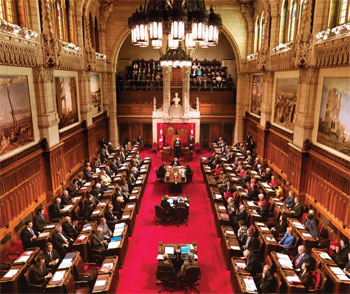
May 30: The Yukon and the Northwest Territories now have seats in the Senate. That brings to 104, the number of Senators who sit in the Red Chamber, the house of sober, second thought.
Prince Edward Island is 'the Garden in the Gulf'. The province's most famous resident is Anne of Green Gables, a character created by author Lucy Maude Montgomery.
June 26: The Supreme Court of Canada rules in favour of Prince Edward Island’s law that forbids non-residents from owning more than four hectares of land.

June 27: Prime Minister Trudeau is on hand in L’Anse aux Meadows, Newfoundland to cut the ribbon and officially open the country’s newest National Park. The 8,000-hectare preserve contains the oldest known settlement in the New World, one belonging to long-ago Viking pioneers.


June 28: Jeff Geddis is born in Thunder Bay. He will grow up to be an actor, starring as Mike Nesmith in the VH1 Daytime Believers: The Monkees’ Story; Andrew Shepherd in the Family Channel series, The Latest Buzz and as Matt Scott on the CBC comedy Sophie.


July 7: The New Democrats elect a university professor to lead their party. Ed Broadbent wins on the fourth ballot, beating out Lorne Nystrom, John Harney and his most formidable opponent, Rosemary Brown. Broadbent will lead the NDP for 15 years before retiring from politics to become director of the International Centre for Human Rights and Democratic Development. In 2004 he will come out of retirement to run for Parliament again.

Springhill, Nova Scotia is the hometown of superstar Anne Murray.

July 20: A raging fire sweeps through the downtown business core of Springhill, Nova Scotia, destroying 25 buildings. Damage is estimated at $3 million.

These USSR stamps honour the Soviet fishing fleet.

July 23: Fishing vessels belonging to the Soviet Union are banned from docking at Canadian ports of call. This drastic measure is taken because the Soviet Atlantic fishing fleet continually ignores set catch quotas. They take what they want. The super trawlers are floating factories. Soon, there won’t be any cod stocks left for anyone. 

July 30: There ís a new kid on the street corner as the federal government orders the creation of Petro-Canada. The Crown corporation will protect national interests. It makes Ottawa a big player in the oil patch; its coast-to-coast-to-coast retail chain is made up from the purchase of Belgium’s Petro-Fina and the American Pacific 66 chains.


August 1: Representatives of Canada are in Finland to sign the Helsinki Accord. The international agreement respects the rights of nations at the same time holding sacred individual human rights. The historic document is signed by delegates from 35 countries in all.


September 1: The CBC purchases CKLW-TV, Channel 9, in Windsor, Ontario. The station’s new call letters are CBET. 
Mirabel International will lose favour as an airport because there is no light, rapid transit to and from Montreal.

October 4: The nation’s newest airport opens in Mirabel, Quebec. The $500 million facility is intended to be a super airport serving both Ottawa and Montreal. Critics call it a white elephant. By 2004 it will only serve cargo planes. 
The SS Edmund Fitzgerald in the Detroit River.

November 10: The SS Edmond Fitzgerald sinks in a violent storm on Lake Superior with all 29 hands on board. The 222-metre long ship was carrying a load of taconite. Folk singer Gordon Lightfoot will immortalize the marine disaster in his ballad The Wreck of the Edmond Fitzgerald.


November 11: The Cree and Inuit of Northern Quebec sign the James Bay and Northern Quebec Agreement. This treaty gives them sovereignty over a portion of Quebec that is the size of Texas.


November 18: Buckle up or pay a big fine in Ontario. The wearing of safety belts in moving automobiles becomes law today. A dramatic public service announcement put out by the provincial Ministry of Transport is aired around the province. It shows a pumpkin flying through the air and smashing into bits on a highway. The question is asked, “If you’re not wearing your seatbelt, what’s holding you back?”


November 18: Ottawa will bail out floundering Canadair. The company that started as Vickers in 1944 will now become a new Crown Corporation. The St. Laurent, Quebec-based manufacturer will be restructured and will develop an Aerospace Division. When profitable, it will be sold to Bombardier in 1986.

November 23: Edmonton squeaks past the Alouettes 9 to 8 on the last play of the game to win the Grey Cup. It is the first time that Calgary has ever hosted a Grey Cup game. This win is sweet revenge for the Eskimos who lost the Grey Cup to Montreal last year.

Canada Post piggy bank.

December 2: By a narrow margin, posties vote to return to work after a six-week strike. The Union of Postal Workers demanded protection from jobs being replaced by machines that can read the new Postal Code, a 40-hour workweek and a $1.70 per hour wage increase over three years. They get the raise but the union position was weakened because more than 2,000 workers crossed picket lines and went to work anyway.

December 3: In a bid to deal with runaway inflation, Ottawa establishes the Anti-Inflation Board to be headed by Jean-Luc Pepin. Voters are outraged; Robert Stanfield’s Tories had announced they would set up such a commission to control prices and wages during last year’s election, which gave the Grits a minority government. 

Bricklin is a fibreglass sports car built in Saint John, New Brunswick.

December 31: The Top Ten selling automobiles for the calendar year are Chevrolet (full size); Ford (full-size); Plymouth Valiant; Chevrolet Malibu; Dodge Dart; Oldsmobile Cutlass; Toyota; Pontiac (full-size); Pontiac LeMans and Chevroletís Nova. At the bottom of the list is Dodge Challenger and Plymouth Barracuda with 13 sales; Bricklin with 22 sales; clearance of last yearís AMC Javelin and Ambassador with 97 sales; the Pontiac Sunbird with 120 sales; Dodge Aspen with 241 sales; Plymouth Volare with 266 sales; Jaguar with 340 sales; Imperial with 369 sales and the Pontiac Acadian with 708 sales.