Showing posts with label Rita MacNeil. Show all posts

Friday, February 28, 2014

1944

From the big scrapbook of time, here’s a look at Canada in 1944--
Workers at Chrysler Canada in Windsor, Ontario turn out Dodge Scout Cars around the clock.

January 1: And then there were two: The CBC inaugurates the Dominion Network. The original CBC is now called the Trans-Canada Network. The new Dominion Network will be a showcase of the best and most popular of homegrown, American and British programming. Folks have 1,558, 060 radio receivers in their homes—only the wealthy can afford radios in their automobiles.

January 3: Household Finance will loan any worker in a war industry the sum of $300 without a co-signer. Payments are $9.46 a month.

January 14: Britain gives Canada two cruisers. Navy Minister Angus Macdonald says the ships are a token gift for all that Canada has done for the United Kingdom during the war.


January 15: Soldiers now have their own newspaper. The Maple Leaf is published by the Canadian Forces and keeps our men and women in uniform up to date as to how the war is going.

January 25: Weather records are being set in Windsor, Ontario as the temperature soars to 15C in Canada’s southernmost urban centre. The warm unusually warm weather has prompted red and black butterflies to appear everywhere in the Rose City.

January 29: There are 580,000 men and women enrolled in the three branches of His Majesty’s Canadian armed forces. 120,000 men have been “struck off strength” as casualties or for other reasons.
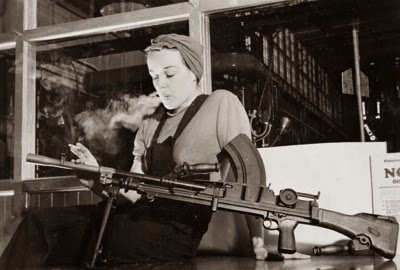
Ronnie the Bren Gun Girl is known from coast to coast, featured as the  poster girl, helping to win the war. She builds weapons at the Inglis factory in Torono.
February 17: The new federal Labour Code goes into effect today. The 2.5 million employees working in war industries have the right to negotiate employment conditions with their employers through an eight-member board that will act as a bargaining agent for the workers. The government hopes this will keep the weapons pouring out of factories. Last year 10,000 workers walked off their jobs, war or not.

The airport at Fort Nelson, British Columbia now belongs to Canada.

February 29: Ottawa will spend $46 million to purchase a string of airports built by the US Corps of Army Engineers. The airports stretch from Edmonton to Alaska and are vital to getting goods to the soldiers fighting in the Pacific Theatre.  The purchase will silence critics who claim that the Liberal government has allowed the Americans to overrun the country and weaken our sovereignty.

March 1: The war may not be over yet but Ottawa is confident enough in victory to end meat rationing here at home.

March 6: Major Paul Triquet of Quebec receives the Victoria Cross for valour in combat. He is the fourth Canadian to be presented with the highest decoration His Majesty can bestow upon soldiers.

March 17: International Air Transport Authority is created to regulate air traffic among nations. IATA’s headquarters will be established in Montreal.

March 20: General Henry Duncan Graham Crerar is appointed chief of the Canadian Army. He will retire from military service in 1946 and accept several diplomatic postings before his death in 1965.

Stephen Leacock will be honoured with a stamp in 1969.
March 28: Humourist Stephen Leacock is dead of cancer at the age of 74. Leacock tickled the nation’s fancy with his amusing stories. The economics professor won the Governor General’s Award for Literature in 1937.

March 29: Terry Jacks is born in Winnipeg. He will grow up to become a Juno winning pop star hitting the charts with songs like Which Way You Going, Billy?, That’s Where I went Wrong and Seasons in the Sun.  

April 13: The Montreal Canadians sweep the Chicago Blackhawks four games to zip to take home the Stanley Cup.
April 14: Fed up with high prices and poor service, Quebec City expropriates Montreal Light, Heat & Power Consolidated and its subsidiary, Beauharnois Light, Heat & Power Company. A new Crown corporation--Hydro-Québec—will serve the people.

April 29: The Royal Canadian Navy destroyer HMCS Athabaskan is torpedoed this night by a German destroyer escort in the English Channel. Sadly, 129 of the goes down with the ship. Another 83 men were picked up from the water are taken prisoner while 44 of the crew members are rescued by the HMCS Haida.

May 1: The Wartime Prices and Trade Board announces that coffee and tea rations will be doubled to 225 grams of tea or a 900 grams of coffee per month. The current rationing coupon still applies.

May 7: A torpedo launched from U-boat 548 hits The HMCS Valleyfield as it sails 80 kilometres south of Cape Race, Newfoundland. The river class frigate sinks, taking 120 souls to the bottom of the Atlantic with her. The HMCS Gifford will rescue 43 but five will die of exposure to the elements.

May 10: The National Wartime Labour Relations Board puts an end to a thirty-day strike in Windsor by 14,000 employees at Ford. Workers have charged Ford with union busting.

The 1940 RCA Victor Little Nipper is manufactured in Canada.
May 11: The Bureau of Broadcast Management is established by the Canadian Association of Broadcasters. The not-for-profit research organization surveys radio listeners from coast to coast to determine out our listening habits, establish ratings for popular programmes and decide what to charge sponsors. The BBM will measure TV viewing habits of Canadians beginning in 1964 and be the first rating service in the world to make use of computer sampling. The company will change its name to BBM Canada in 2001.
May 24: The HMCS Shawinigan is torpedoed by a U-Boat while on a routine patrol of the Cabot Strait, near Port-aux-Basques, Newfoundland. All 91 hands on board the corvette drowned.

May 28: It’s a girl for coal miner Neil MacNeil and his wife Renee of Big Pond, Cape Breton, Nova Scotia. Daughter Rita will grow up to be one of the most loved and successful recording artists in the industry. Three Junos, four Canadian Country Music Industry awards, five honourary doctorates, seven East Coast Music Awards and the Order of Canada won’t change the enchanting songstress one bit. Cape Breton's First Lady of Song will die of post surgical complications in 2013 at the age of 68.


June 6: More than 175,00 Allied troops storm the beaches at Normandy, France. Two brigades of the 3rd Canadian Infantry Division land at 7:45 AM, local time. Within an hour of landing the division will sustain 50 percent casualties.

June 15: The Canadian, British and American governments will cooperate to build a nuclear energy facility in Chalk River, Ontario. Located 200 kilometres west of Ottawa, the plant will be designed and built by engineers from the National Research Council.

June 29: Charlie Watt is born in Fort Chimo, (Kuujjuaq) Quebec. He will grow up to work for Indian and Northern Affairs and found the Makivik Corporation that will lead the Inuit of Arctic Quebec to form Nunavik. In 1984 Prime Minister Trudeau will appoint him to the Senate, the first Inuk to be so honoured.
Dominion Day: Four people are killed when a pair of deadly tornadoes touches down in Lebret, Saskatchewan.

July 3: Folks in Labrador suffer through scorching heat. The temperature in Goose Bay reaches 37.8C, the hottest it’s ever been.
July 7: The CBC will now collect an annual license fee of $2.50 per radio. The plan is to use the money reduce the amount of advertising heard on air. Last year the CBC grossed $2.9 million through advertising.

July 10: There is a new kind of government for citizens of Saskatchewan as Tommy Douglas, leader of the Cooperative Commonwealth Federation, is sworn in as Premier of the province.

Both Ford and GM built Canadian Military Pattern Trucks for the war effort.
August-- More than 700,000 motorized, made-in Canada war machines are on the job, fighting for victory. Universal carriers, scout cars, artillery tractors and trailers, troop and ammunition transports, mobile service workshops, fire trucks, radio trucks and ambulances are pouring out of factories at the unprecedented rate of 3,800 units a week.

August 1: The Family Allowance Programme passes unanimously in Parliament. The scheme will cost $250 million to administrate. Better known as the baby bonus, every mother in the Dominion will receive a monthly cheque.


August 9: Three tornadoes rip through the village of Kamsack, Saskatchewan, destroying 400 homes and 100 businesses. The death toll is three and damage is pegged at $2 million.

August 17: Nearly a million Canadians, one out every ten citizens, is in uniform fighting for King and Country. Farm labour is in such short supply that the Army sends out fresh recruits to harvest tobacco.

The Poplar Hill School serves the municipalites of Daly, Whitehead, Elton and Cornwallis, Manitoba. The one-room school will close in 1967, the 24 students will be sent to larger schools.
September 7: No more pencils, no more books, no more teachers' dirty looks. Lots of kids living in rural Manitoba, Saskatchewan and Alberta get an extra long summer holiday. More than 500 one-room schools in the Prairie Provinces can’t open because there are no teachers to be had.

September –: The CBC launches its own radio station in Halifax. Folks can now tune the dial to 1240 on the AM dial for their favourite programmes. Previously private affiliate CHNS carried some programmes as well as on CHNX, its shortwave relay. CBH will move to the FM band in 1977.

September 16: Prime Minister Mackenzie King, US President Roosevelt and British Prime Minister Churchill meet in Quebec City to determine what to do with Europe and Asia when the war ends.


September 20: It is reported that diphtheria has clamed the lives of 25 percent of the Inuit living in Arviat, Nunavut (Eskimo Point, NWT).

September 30: Diane Defresne is born in Montreal. She will grow up to be a rock star, known the world over for her raucous stage antics, incredible voice range and her uninhibited rock-n-roll style, the chanteuse is an icon throughout the Francophone world, richer and more popular than the Beatles.

October 21: Ernest “Smokey” Smith earns the Victoria Cross today for exceptional valour in the face of enemy fire in Italy. The British Columbia native will die at home in 2005 at the age of 91. His ashes will lie in state in the foyer of the House of Commons and flags throughout the land will be flown at half-mast in his memory.


November 3: Jack Miner is dead in Kingsville, Ontario. The naturalist, author and lecturer created a bird sanctuary on his farm in 1904 and banded more than 50,000 ducks in his lifetime. Last year, King George V1 awarded the nature lover with the Order of the British Empire for his conservation efforts. Newspapers say that he is the fifth best-known person in North America after Ford, Edison, Lindbergh and Rickenbacker. A museum will open in 1977 that showcases his important work.

November 13: Defense Minister Colonel James Layton Ralston is forced to resign from Cabinet when he is unable to convince the Prime Minister to introduce mandatory conscription. Bill 80 will be invoked to require inscription in a few weeks. The 16,000 new conscripts will boost morale of soldiers on the front lines who are exhausted and have no replacements.

November 17: Lorne Michael Lipowitz is born in Toronto. He will change his name to Lorne Michaels, move to Los Angeles and write for comedy shows and sitcoms before developing such wildly funny television shows as Saturday Night Live and Kids in the Hall.
 
Johnny Taylor is MVP and will return to play for the Montreal Allouettes after the war.
November 25: The St. Hyacinthe-Donnacona  Royal Canadian Navy team bests the Hamilton Wildcats to win the Grey Cup. The final score is seven to six.

December 11: Camillien Houde is re-elected as the Mayor of Montreal by 14,000 votes. Houde was recently released from a four-year prison term. His Worship was convicted of sedition under the War Measures Act for speaking out against compulsory military service.

December 22: The Wartime Prices and Trade Board rules that landlords must rent to families with children. Landlords are also forbidden from withdrawing any rental property from the market until they receive further official notice and permission to do so.

December 24: A German U-boat, lurking outside of Halifax Harbour, torpedoes and sinks the Bangor class minesweeper, the HMCS Clayoquot. Eight hands were lost.

This Chevrolet Heavy Utility Ambulance, a.k.a.  the C15TA is a 15-cwt 4x4 armoured truck that uses GM Canada's six-cylinder  4.4-litre (270-cubic inch) engine and is fitted with a two-ratio gearbox. Hulls are built by the Hamilton Bridge Company.During 1943/1944 GM Canada will manufacture 3,961 C15TAs at the Oshawa plant at a price of $4.500 each. 3,000 are ordered by the British and the rest are shipped to the Canadian Armed Forces.


Thursday, January 24, 2013

1990

From the big scrapbook of time, here’s a look at Canada in 1990-


January 5: The economy of Newfoundland and Labrador reels as seafood processing giant Fishery Products International announces the closure of three plants. More than 1,300 people will lose their jobs.

January 15: Parliament slashes VIA Rail’s budget.  Many routes will be affected by the cuts including the rerouting of The Canadian. Now service from Toronto to Vancouver will be available only three days a week. The famed stainless-steel train with its domed observation cars will make the 4,466-kilometre trek along  the Canadian National route, one far less scenic than the more southern route owned by the Canadian Pacific Railway.


January 24: A national sales tax is tabled in the House of Commons. The Progressive Conservative government of Brian Mulroney intends for Canadians to pay a tax on all goods and services.


January 29: Her Excellency, Jeanne Sauve, steps down as Governor General. Sworn in to serve as the nation’s 24th Governor General is Ramon John Hnatyshyn. The Saskatchewan native was Minister of Justice in Brian Mulroney’s cabinet. 


February 12: An environmental disaster, a mountain of tires catches fire in the village of Townsend, near Hagersville, Ontario. It is estimated that 14 million tires burning. Thick, dark, toxic smoke will blanket the area, forcing more than 4,000 people out of their homes. The fire will burn for 17 days before firefighters finally extinguish the blaze.


March 8: Paul Quarrington is at Rideau Hall to receive the Governor General's Literary Award for English Fiction with his novel, Whale Music. It is the 51st year for the award.

March 9: The Lake Meech Accord is in trouble. Newfoundland and Labrador Premier, Clyde Wells, announces his newly elected government will revoke the constitutional amendment package because it will erode the province's powers. 


March 15: Ottawa announces that men practising the Sikh religion may wear their turbans as part of their Royal Canadian Mounted Police uniforms.

A Chinese Head Tax Certificate.
 March 17: Ottawa will give $50 to $500 per person as compensation to Chinese-Canadians who forced to pay $23 million for admission to Canada between 1885-1923.  
 
Rita MacNeil hails from Big Pond on Cape Breton Island. She is the nation's biggest country and folk singer..
 March 18: Rick Moranis hosts the Juno Awards, held at the O’Keefe Centre in Toronto. Rita MacNeil wins a Juno for Best Female Vocalist. Kim Mitchell takes home a Best Male Vocalist Juno. Best Album Juno goes to Alannah Myles and so does the Juno for Single of the Year for her song, Black Velvet.
Bridgetown, Barbados as seen from the harbour. Parliament is the building with the flag.
 March 19: Prime Minister Mulroney is in Bridgetown, Barbados for the Caribbean Commonwealth leaders’ conference.  Canada forgives $182 million worth of debt racked up by Caribbean nations.
 
The $1000 bill will be withdrawn from circulation on May 8th, 2000.
 March 20: Ottawa now requires banks to track large cash deposits in order to keep criminals from laundering money.
 

March 22: Gerald Vincent Bull is assassinated in Brussels. The North Bay, Ontario native was an armament designer and created a “super gun” for the Iraqi military. It is believed he was shot by Mossad agents. Gerald Forsythe’s novel, The Fist of God, recounts the engineer’s life story.

March 29: Federal Environment Minister Lucien Bouchard shows his Green Paper—a document that will address today’s environmental problems.


April 1: Ottawa inks a land claim deal with First Nations people of the Yukon Territory. The settlement includes 41,000 square kilometres of land, mineral rights and $232 million in cash.
This Hydro Quebec dam is located near the Cree settlement of  Chisasibi.
April 3: Quebec Cree Grand Chief Matthew Coon-Come files for an injunction to stop Hydro Quebec from implementing phase two of the $7.5 billion expansion Great Whale Hydro development project on James Bay. Coon-Come says that flooding the 5,000-square kilometres of land will irrevocably harm the environment as well as alter the Cree people’s traditional way of life, Pressure tactics will cause New York State to withdraw from signing multi-billion dollar agreements with Hydro Quebec, effectively killing the mega-project.

April 4: Alannah Myles hit, Black Velvet, climbs to Number One on the American pop singles chart.  The Toronto singer and songwriter will have two other Top 40 hits from her debut album.

April 9: An Angus Reid poll shows the Mulroney Tories have the support of only 15 percent of decided voters. It is the lowest poll on record for a sitting government.
The House of Commons in session.
April 10: After nine months of vicious fighting, the bill for the controversial Goods and Services Tax passes in the House of Commons. The vote is 144 yeas to 114 nays.  The 7% percent will replace the 13.5 percent Manufacturers Sales Tax. The bill now goes to the Senate for approval and then to the Governor General for Royal assent.

April 11: Harold Ballard is dead at the age of 86. The sports legend was the owner of the Toronto Maple Leafs and Maple Leaf Gardens. He leaves behind an estate valued at $50 million—most of it donated to charities.

April 19:The Crown lays charges against five teens for setting a fire at the Tyre King Recycling centre in Hagersville, Ontario. The 14 million scrap tires burned for seventeen days.  
In 1954, Woodward's opened an ultra-modern store in uptown New Westminster, BC.
April 27: Charles Woodward is dead at the age of 66. The business tycoon was head of Woodward's Department Stores Ltd for more than 30 years.  He added 21 stores to the family-owned chain before resigning in 1988 and selling to The Hudson’s Bay Company.
 

May 3: The nine justices of the Supreme Court of Canada rule unanimously that Angelique Lyn Lavallee of Winnipeg acted in self defence when she killed her long-time partner after years of abuse on August 30, 1986. The battered wife syndrome becomes a legitimate defence in murder charges.


May 12: Federal Environment Minister, Lucien Bouchard, is alarmed that changes may be made in the Meech Lake Accord. He resigns from the Tory government. In a few short months he will be back in politics as the leader of the newly formed Bloc Quebecois.

May 16: A tire dump near St. Amable, Quebec catches fire. An estimated 10 million tires burn over the next six days and hundreds are forced from their homes before firefighters can extinguish the blaze. It is estimated that there are 25 million old tires in similar dumps around Quebec. Cement giants Lafarge Canada in St. Constant and Ciment Saint-Laurent in Joliette will sign a contract with officials in Quebec City in 2001 to burn 7.5 million of the old tires, converting them into fuel for their cement plants.


“Sorry Charlie, Starkist doesn’t want tuna with good taste, but tuna that tastes good.”
 May 17: As a result of the ‘tainted tuna scandal’ Star-Kist Canada will shutter its factory and abandon the Canadian market.  In 1985, a million cans of spoiled tuna were processed in the company's cannery in St. Andrews, New Brunswick.  The Federal Minister of Fisheries overrode the inspectors' decision. Only when The Fifth Estate broke the story on its news show were the cans yanked off store shelves. Closure of the plant has put 400 people out of work.

Royal Air Force Panavia Tornados on a training exercise at CFB Goose Bay.
May 22: NATO announces it will cancel the low-level flight training centre for member nations at Canadian Forces Base Goose Bay in Labrador.

This the Oilers' fifth Stanley Cup victory in seven years.
May 24: The Edmonton Oilers beat the Boston Bruins four games to one, to win the Stanley Cup.

May 31: Alberta will sell off half of its Crown corporation, Alberta Government Telephones, established by the Liberal government in 1906. It is estimated that the sale of AGT will bring $1.5 million into the government’s coffers. The company will be known as Telus in 1996.


Senator Waters
June 6: The Honourable Stanley Charles Waters is sworn in as Canada’s first elected Senator. Representing the Reform Party and the people of Alberta, he will press for a “triple E” senate—elected, effective and equal. The idea is not popular and will eventually be abandoned. Senator Waters will die of brain cancer in 1991.


June 10: With only 20 days to go before it dies, the First Ministers gather together to renegotiate and sign a new version of the Lake Meech Accord. Premier Clyde Wells says he will have to take it to the people of Newfoundland and Labrador before signing.


June 12: Rising in the Manitoba legislature, eagle feather in hand, Member of the Legislative Assembly Elijah Harper says “no” to the Lake Meech Accord. The Cree band chief and provincial politician objects to the constitutional package because First Nations people were not consulted.
Miracle Food Mart in Windsor, Ontario.
July 20: Quebec grocery giant Steinberg sells 58 of its Miracle Food Mart and 11 Ultra-Mart stores for $235 million. Most of the stores are in the Greater Toronto Area and will be operated under the A&P or Dominion banners.

Russ Munro reported the D-Day invasion of Normandy in 1944.
June 21: Ross Munro is dead in Toronto at the age of 76.  He was a war correspondent for Canadian Press during World War Two. He was editor and publisher of the Edmonton Journal, Winnipeg Tribune and the Montreal Gazette.


June 23: The Meech Lake Accord is dead. Quebeckers feel left out of national life.

The Right Honourable John Turner was the 17th Prime Minister.
June 23: Former Prime Minister John Turner has stepped down as leader of the Liberal Party. Jean Chretien wins the leadership race on the first ballot at the convention in Calgary.

June 28: Federal Health Minister Perrin Beatty announces Ottawa will spend $112 million on a national AIDS strategy. The money will be used to stop transmission of the disease, search for a cure, and develop education programmes.


July 11: A land dispute between the Mohawk people and officials of the town of Oka, Quebec escalates into armed conflict. Three people will die. Mohawks barricade themselves and the army will bring tanks and throw up a razor wire barrier. The standoff will last 78 days before being peaceably resolved.
Wayne and Shuster were Ed Sullivan's favourite comedy duo--appearing on his CBS variety show 67 times, more than any other performers.

July 18:  Louis Weingarten is dead of brain cancer at the age of 72. Better known to Canadians as Johny Wayne, he was half of the famed comedic duo Wayne & Shuster. They have performed together since the 1930s. There is an old joke that real Canadians are easy to identify—they’re the ones who know which one is Wayne and which one is Shuster. Johnny Wayne will be buried in his hometown of Toronto. 
Joseph Gaétan Robert Gérald (Gerry) Boulet
July 18: Gerry Boulet is dead at the age of 44. The lead singer of Offenbach was described as having “ a voice that grated asphalt at 500 kilometres an hour.” The rock star succumbed to colon cancer in Montreal.

August 25: Novelist Morley Callaghan is dead in Toronto at the age of 87. One of this country’s best short story writers, Morley once knocked out buddy Ernest Hemmingway in a boxing match in Paris. Morley was also the host of the long-running programme Anthology, heard on Saturday nights on CBC Radio.
The 1991 Mercury Grand Marquis. The Mercury brand will be dropped in Canada at the end of the 1999 model year.
September – An eight-day strike at Ford Canada is settled and retooling at the St. Thomas and Oakville plants get under way. The Mercury Grand Marquis and the Ford Crown Victoria will be built in St. Thomas and the new mid-sized vans will be built in Oakville.
Robert Keith"Bob" Rae was Ontario's 21st Premier, serving from 1991 to 1995.
September 6: With 74 orange seats at Queen’s Park, Bob Rae leads the New Democratic Party to a surprise majority victory in the Ontario election.

September 26: The Oka Crisis is over. Mohawk warriors throw their weapons into a fire, burn tobacco in a peace ceremony and walk out of the pine woods. They are detained by the army and arrested by the Surete du Quebec.

September 27: To ensure passage of the Goods & Services Tax, Prime Minister Mulroney enlarges the size of the Senate and appoints a dozen new Tory Senators to the Red Chamber.
Craig Russell as Judy Garland.
October 30: Craig Russell is dead of a stroke at the age of 42. Famous for his impressions of a dozen Hollywood divas—from Mae West to Bette Midler—the movie star and female impersonator will be laid to rest in Port Perry, Ontario.

November 7: Author and English professor Hugh MacLennan is dead in North Hatley, Quebec at the age of 83. Born in Glace Bay, Nova Scotia, he will be best remembered for his classic novels Barometer Rising and Two Solitiudes. The Tragically Hip pay homage to Hugh with their song Courage—recorded on their 1992 album, Fully Completely.


November 16: Northern Dancer is dead at the age of 29. Inducted into the Canadian Sports Hall of Fame in 1965, the 1964 Kentucky Derby and Preakness winner was the most successful thoroughbred horse of the 20th Century. Canada Post will honour the horse with a stamp in 1999.
November 25: The Winnipeg Blue Bombers whip the Edmonton Eskimos at the 78th Grey Cup. The score is 50 to 11.  

December 9:   The widow, Marguerite d'Youville, founder of the Sisters of Charity, a.k.a. the Grey Nuns, is the first Canadian to be canonized by Pope John Paul. St. Margeurite’s feast day will be every October 16.

December 17: By Royal Assent, the GST becomes law and will take effect on January 1, 1991. The national sales tax is set at 7 percent.