Showing posts with label The Guess Who. Show all posts

Monday, February 10, 2014

1949

  From the big scrapbook of time, here’s a look at Canada in 1949-


January 15: An RCAF Northstar DC-4 flies the Great Circle route across the Arctic from Vancouver to Halifax. This marks the first non-stop flight across the Dominion. The trip takes eight-and-a-half hours, covers 4,630 kilometres and shows both the Americans and the Soviets that the Canadian military can and will look after our own back yard.

January 24: Guy Charron is born in Verdun, Quebec. He will grow up to play for the Montreal Canadiens, the Detroit Red Wings, the Kansas City Scouts and the Washington Capitols before hanging up his skates in 1981.

February 1: The Saskatchewan Power Corporation is created. The new crown corporation is responsible for generating, transmitting and selling hydro-electricity throughout the province.

The Johns-Mansville mine in Asbestos, Quebec will close in 2011.

February 14: Some 5,000 asbestos miners walk out in a wildcat strike against employer Johns-Mansville in the town of Asbestos, Quebec. Those walking the lines want to earn $1 an hour, have two weeks’ paid holidays, a significant reduction in asbestos dust in the factories and arbitration according to the Rand Formula. Management thinks the requests are ridiculous and Premier Maurice Duplessis declares the strike to be illegal.

February 23: Marc Garneau is born in Quebec City. He will grow up to be a Captain in the Royal Canadian Navy and the first Canadian to blast off into outer space in 1984. Marc will be elected to Parliament in 2008.

March 10: Aviator Eric Blackwood of Brookfield, Bonavista Bay, Newfoundland founds Eastern Provincial Airways. EPA will start modestly, taking to the skies with a single Twin Cessna 50. Eric will sell his hugely successful airline to Canadian Pacific in 1984 and the EPA name will fade into history two years later.

March 11: Delegates from Canada are in Brussels along with counterparts from the UK, the US, Belgium, France, Holland, Luxembourg and Norway to write the North Atlantic Security Treaty. This pact will lead to the creation of the North Atlantic Treaty Organization, better known as NATO. 

March 16: Victor Joseph Garber is born in London, Ontario. He will grow up to become a singer and actor. He will star as Jesus in Godspell and John Wilkes Booth in Assassins but he is best known for his role as Jack Bristow in the TV series, Alias.

Joseph R. Smallwood signs the agreement that makes Newfoundland and Labrador part of Canada. Smallwood will be the province's first premier.
March 31: A full 82 years after refusing to join New Brunswick, Nova Scotia, Quebec and Ontario in Confederation, the British colony of Newfoundland and Labrador becomes part of Canada. Home to the largest and richest fish stocks in the world the once-independent Dominion becomes Canada’s tenth province.

The March of Dimes launches its first Easter Seals campaign in Sydney, Nova Scotia. The rest of the province will join the cause in 1952.
April 1: Polio sweeps the nation. No one   anywhere seems to be immune from this crippling disease. The Ontario Ministry of Health quarantines victims living in Toronto.

April 4: The North American Treaty Organization is a new military alliance created to thwart Soviet plans to dominate the world. Lester B. Pearson, Minister of External Affairs, inks the deal in Washington, DC, making Canada a charter member of NATO.

April 16: The Toronto Maple Leafs shut out the Detroit Red Wings to earn Lord Stanley’s Cup. This is the second year in a row that the Leafs have beaten the Red Wings and it's the third consecutive Stanley Cup win for Toronto.

Toller Cranston will be the most influential skater of the Twentieth Century.
April 20: Toller Shalitoe Montague Cranston is born in Hamilton, Ontario. He will grow up in Kirkland Lake and be the Canadian national figure skating champion from 1971 to 1976. He will earn bronze at the 1974 and 1976 Olympics and become World Professional Champion in 1988. His autobiography, When Hell Freezes Over Should I Bring My Skates? will be published in 2000.

April 28: The British Empire is a thing of the past as King George VI signs the London Declaration, creating the British Commonwealth of Nations.  There will be 53 member nations in 2008.


May 5: Some 5,000 striking workers at the Johns-Manville plant in Asbestos, Quebec go on a rampage throughout the sleepy Eastern Townships village when they learn that management has hired scab workers.  Homes are trashed and people are beaten. Premier Duplessis sends 400 heavily armed police who arrest hundreds of men. This is the worst strike in Quebec history. The Archbishop of Quebec will step in to arbitrate and finally put an end to the bloody strike on July 1st.

May 18: Bill Wallace is born in Winnipeg. He will grow up to be a musician playing base and singing for The Guess Who. He will write classic rock hits such as Bus Rider, Hand Me Down World, Clap for the Wolfman, Road Food and Follow Your Daughter Home.


May 18: A full 18 percent of the citizens of Windsor, Ontario are members of the United Auto Workers. Chrysler and Ford have their national headquarters Canada’s southwestern city.
Dave Thomas will be best known for his Doug Mackenzie character on SCTV.

May 20:  It’s a boy for John and Moreen Thomas of St. Catherines, Ontario. Dave will grow up to become an Emmy and Juno-winning actor who will star in many movies.

June 13: The mercury shimmies up the thermometer scale to reach 36.1C, making this the hottest day ever in the Yukon.

June 15: Alberta will never be the same. The provincial government sells a gas lease to the private sector for $3 million. Gas and oil will make the Wild Rose Province rich.


June 21: Jane Urquhart is born in Little Longlac, Ontario—some 380 kilometres north of Thunder Bay. She will grow up to become a writer, winning the Governor General’s Award for her novel, The Underpainter.
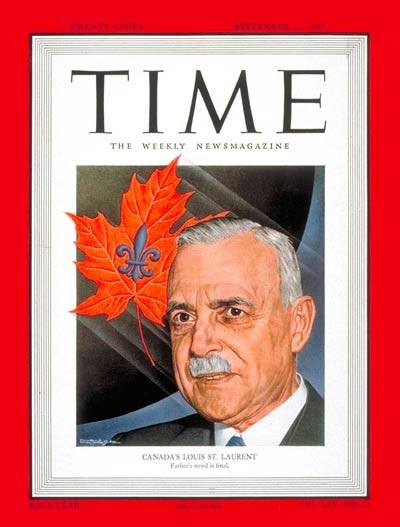
The Right Honourable Louis St. Laurent is our 12th Prime Minister.

June 27: Led by Prime Minister Louis St. Laurent, the Liberals romp to victory in the biggest majority ever given to a political party. This is the fourth back-to-back majority the electorate has handed to the Grits.

July 11: Liona Boyd is born in London, England. When she is eight, her family will move to Canada. She will grow up to become one of the world’s most accomplished guitarists. The “First Lady of the Guitar” will be made a Member of the Order of Canada in 1981.

July 19. The village of Cheneville, Quebec is wiped out by a tornado that wreaked its havoc in three minutes.
The Avro C-102 will be commemorated by Canada Post in 2013.

August 10: Avro is the world’s most advanced jet airplane builder. The company makes aviation history with the first flight of its C-102 passenger jet. The jetliner takes off from Malton Airport, west of Toronto, carrying 50 passengers at nearly 1,000 kilometres an hour.

August 12: Planet Earth becomes a much more dangerous place to live as the Soviet Union tests its first atomic bomb.


August 21: Much of British Columbia is rocked by a large earthquake, centred on the Queen Charlotte Fault. Cows are knocked off their feet and in Terrace, standing on the street was “like being on the heaving deck of a ship at sea. Effects are felt as far away as Whitehorse. Although this is the largest earthquake to ever hit the country, there are no deaths and very little damage.


September – Hundreds of thousands of listeners tune in to a new 'flagship show' that debuts on the Trans-Canada network of the CBC. The Wednesday Night series features dramas, music, intellectual discussions and more.  Folks can still tune in to hear old favourites including Don McNeil’s Breakfast Show sponsored by Quaker Oats, the Russ Titus Show, sponsored by Toni Home Permanents and Wayne and Shuster brought to you by RCA Victor.

September 7: Jack hammers, steam shoves and backhoes rip up Yonge Street in Toronto as construction begins on a subway system. The project is estimated to cost $50 million.

September 9: A Canadian Pacific Airlines DC-3, bound from Quebec City to Baie-Comeau, is blown out of the sky near the town of St-Joachim. All 32 on board perish. The RCMP will determine the bomb was made by a watchmaker to punish his wife for cheating on him. Albert Guay will be hanged for the murders. The tragic tale will become a best-seller, The Crime of Ovide Plouffe. The book will be made into a movie in 1984.


September 16: The 110-metre long, 1095-tonne SS Noronic is destroyed by fire while docked at Pier Nine in Toronto. The largest and most beautiful passenger ship on the Great Lakes was on a seven-day cruise that started in Detroit. It is estimated that between 118 to 139 passengers were killed. An inquiry will show the fire started in a linen closet, probably started by a dropped cigarette.

October 25: Laurie Skreslet is born in Calgary. In 1982 He will become the first Canadian to climb Mt. Everest.

November 26: This is the 37th match and the Montreal Allouettes beat the Calgary  Stampeders 28 to 15 to take home the Grey Cup.

November 28: Paul Shaffer is born in Thunder Bay. He will grow up to be a bandleader, appearing for many years on The David Letterman Show.

November 29: It’s a boy for Nathan “Al” Rogers and wife Valerie who have moved up to Hamilton, Ontario from Nova Scotia to look for work. Son Stan will grow up to become a folk singer, famous for his rich baritone ballads. He will die at the age of 33 in a fire on board Air Canada flight 797.

December 11: The federal government’s new criminal code is so restrictive that it all depictions of crime are forbidden. This includes the current issues of Batman and Superman comic books.


Workers at Studebaker in Hamilton, Ontario built 11,998 passenger cars this calendar year.

December 31: Workers built 193,826 automobiles this year.

Tuesday, July 16, 2013

1971

From the big scrapbook of time, here’s a look at Canada in 1971--

 Imported from France by Chrysler Canada, the 1971 Simca sold 1,464 units during the calendar year. Canada-wide, 578,479 new cars will be sold this year.

January 5: Douglas G. Shearer is dead at the age of 71. The seven-time Oscar winner was born and raised in Montreal. He loved sound and spent 40 years in Hollywood developing sophisticated sound systems for the movie industry.

January 18:  Seamus O’Regan is born in St. John’s, Newfoundland. He will become a cub reporter for the CBC at the age of ten and co-host of CTV’s popular morning show, Canada AM, for a decade before becoming a reporter for the CTV National News.

Patrice buckles up with Stanley, a  VIP passenger.
January 27: Patrice Brisebois is born in Montreal. Noted for a smooth slapshot, he will grow up to play hockey as a defenceman for the Montreal Canadiens and the Colorado Avalanche.

February 1: The General Council of the United Church of Canada rules that abortion is morally justifiable under “certain medical social and economical circumstances.”


February 22:  The Juno Awards are held at St. Lawrence Hall in Toronto. Anne Murray and Gordon Lightfoot win Junos in hte best female and male vocalist categories. The Guess Who is group of the year.

March 2: Canadian National Railway wants to drop the Super Continental passenger service between Toronto and Vancouver but the Canadian Transport Commission orders the CNR to keep that train on the tracks despite the fact that it runs deep in red ink. The spectacular run across western Canada will be deleted in 1981, then revived from 1985 to 1990 before being scuttled a second time.

March 4: The country’s most eligible bachelor, Pierre Elliot Trudeau weds Margaret Sinclair in Vancouver. The 51-year old Prime Minister first met his bride on a Tahitian holiday in 1968.


March 13: FLQ Terrorist Paul Rose is convicted of the murder of provincial cabinet minister, Pierre LaPorte. The 27-year old Rose is sentenced to life imprisonment. He will be paroled in 1982 and die of a heart attack in 2013.

March 22: Bluenose politicians need to look sharp as radio and TV now broadcast the proceedings in Nova Scotia’s House of Assembly.

March 29: The Cold War thaws as Prime Minister Trudeau appoints Ralph E. Collins to be the first Canadian Ambassador to the People's Republic of China.

Hydro-Quebec's Gentilly nuclear power plant will look like this in 2009.
April 5: The first CANDU reactor goes on line in Gentilly, Quebec. Developed by Atomic Energy of Canada, Limited, the nuclear reactor uses un-enriched uranium as its power source.

April 5: Frances Phipps becomes the first woman—and the first Canadian woman--to reach the North Pole. She and her husband Welland “Weldy” Phipps have been living in Resolute, Nunavut since 1958 and operating Atlas Aviation—the most northerly charter service in the world.

April 9: It’s a boy for Gilles and Joanne Villeneuve. Son Jacques is born in St-Jean-sur-Richelieu, Quebec. Though his father is killed when he is eleven, Jacques will follow his dad’s lead, live life in the fast line to win the Formula One and Champcars championships. He will be considered by many to be the best race driver in the world.

April 14: Inmates at the maximum security prison in Kingston, Ontario riot. Over the next four days they will hold six guards hostage. Two prisoners will be killed and 11 others injured. Built in 1835, the Kingston Pen will be closed in 2014.

April 24: Labour lawyer and party theorist David Lewis is elected leader of the New Democratic Party. He will lead the party for four years, teach at Carleton University and die of cancer in 1981.


May 1: The times they are a-changing as the Dominion Bureau of Statistics changes its name to the fresher—and more bilingual--Statistics Canada.

Canada Post issued this commorative stamp to mark British Columbia's 100th year as a partner in Confederation.

May 3: Queen Elizabeth II, Prince Philip and Princess Anne arrive in British Columbia to kick off the festivities that mark the province’s centennial year. The royals will stay for a week.

May 4: An enormous sinkhole appears from nowhere in St-Jean-Vianney, Quebec and swallows up 40 homes in the village. The disaster claims 31 lives. Scientists will determine the cause to be a combination of torrential rains combined with a rare subsoil that turns to mush when saturated. The nearby town of Lemieux, Ontario shares the same subsoil and will be abandoned in 1991, saving lives when the Main Street disappears in 1993.

May 12: Canada and the United States are engaged in bilateral talks to improve the quality of water in the Great Lakes. Pollution is destroying the entire eco-system.

May 20: FLQ terrorist Francis Simard is sentenced to life imprisonment for his role in the murder of provincial labour minister, Pierre LaPorte. He will be paroled in 1982 and write about the October Crisis. His book Pour en finir avec octobre will be made into a movie, Octobre, in 1994.


May 18: The Canadiens skate to the Stanley Cup after whipping the Chicago Blackhawks, four games to two.

May 22: Ontario Place opens in Toronto’s Harbourfront. The $23 million facility quickly becomes a fun destination, boasting rides, shows, fireworks and the world’s first IMAX theatre.

May 22: Tragedy strikes at sea during the wee hours of the morning when a flash fire breaks out on the below decks forward in the crew area of the 90-metre liner, Meteor. The Norwegian cruise ship is only 100 kilometres from Vancouver. The fire spreads so quickly that 32 of 91 crewmembers suffocate or are burnt to death in a matter of minutes. None of the 67 passengers on board is injured.

May 31: Monika Schnarre is born in Toronto. She will grow up to be 1.87 metres tall and win the Supermodel of the World Contest when she is 14. Her career will include TV and movies as well as a biography, Monika: Between Me and You. In 2007 she will become an ambassador representing Habitat for Humanity.

June 3: The highly controversial Spadina Expressway in Toronto is cancelled by Ontario Premier Davis, who says, “"If we are building a transportation system to serve the automobile, the Spadina Expressway would be a good place to start. But if we are building a transportation system to serve people, the Spadina Expressway is a good place to stop." Construction began in 1964.


June 8: The Canadian Medical Association issues a statement to the press that abortion should be decriminalized, that the procedure should be a private matter between a woman and her physician. Abortion has been legal since 1968 as long as a medical team determines the procedure needs to be performed. The Supreme Court will strike down abortion laws in 1998 because the justices rule they are unconstitutional.

June 11: The country takes its first green step. Prime Minister Trudeau appoints Jack Davis to the cabinet as the first federal Minister of the Environment.

First Ministers sign the Victoria Charter today.

June 14: The Victoria Charter to amend the British North America Act is signed by all the First Ministers. It will ultimately be rejected by Quebec. It won't be until 1982 that our Constitution comes  home to Canada.

June 21: The Ontario Development Corporation lends $961.645 to Toronto publishers McClelland & Stewart so it won’t be bought out by a foreign company. Founded in 1906 the publisher’s stable of writers include such icons as Margaret Atwood, Pierre Berton, Leonard Cohen, Peter Gzowski, Margaret Laurence, Farley Mowat, Michael Ondaatje and Mordecai Richler.
June 24: The federal government announces it will pay out $1.5 million to people who have been made ill by mercury contamination.


July:  Alberta and Ontario lower the age of majority from 21 to 18 years of age.

July 30: Michael Thomas Green is born in Pembrooke, Ontario. The budding comic will irritate his family with his shocking humour but Americans will love his antics. He will star in the Tom Green Show and become a mega superstar when the show moves to MTV. He will star in such movies as Road Trip and Freddy Got Fingered.


July 1: Happy birthday, Canada! Prime Minister Trudeau announces that $2.5 million is earmarked for a Museom of Antrhropology to be built on the campus of the University of British Columbia. It will showcase Aboriginal life and history.
The Bluenose II is 46 metres long and weighs 246 tonnes.

July 29: The Oland family of brewing fame sells the Province of Nova Scotia the schooner Bluenose II for one dollar. Launched in Lunenberg, Nova Scotia on July 24, 1964, it is an exact replica of the famed Bluenose that appears on the obverse side of the dime. The schooner is one of the greatest goodwill ambassadors that Nova Scotia and Canada could have.

July 22: The Toronto Board of Education abolishes use of the strap by teachers as a form of student discipline in schools.
Banff Centre.

August 15: The Banff Festival of the Arts opens for the first time. By 2005 it will be one of the top 100 most popularly attended cultural festivals in the world.

August 16: Hurricane Beth batters Nova Scotia, dumping 25 centimetres of rain on Halifax and polluting Dartmouth’s water supply. The tropical twister washes out bridges, destroys highways and ruins crops. Fortunately no lives are lost but damage reaches $3 million.

October 4: Exploration shows there are large petroleum deposits under Sable Island. Part of Nova Scotia, the island sandbar lies 180 kilometres from the mainland is notorious for more than 300 shipwrecks on its shores. The three-trillion litre gas discovery will allow to Nova Scotia to be a “have” province in the early 21st Century.

As practical as it is pretty, the 1971 Dodge Dart is the seventh best selling nameplate this year.

October 8: In a rare show of support, the Opposition leaders declare their support for the Liberal government policy of multiculturalism within a bilingual framework.

November 1: There’s a new paper on the stands as the Toronto Sun appears for the first time. The tabloid will be noted for its racy slant on the news, the “Sunshine Girl” and “Sunshine Boy” pinups and have a weekday circulation of 200,000 in 2008.

November 2: Gerhard Herzberg wins the Nobel Prize for chemistry. Born in Germany, the scientist fled the Nazis in 1935 and immigrated to Canada. He will die in 1999 at the age of 94.

November 12: Air Canada stewardess, Mary Dohey, has a sawed-off shotgun held to her head for more than six hours as a highjacker, armed with two bundles of dynamite threatens to blow up the Calgary to Toronto-bound DC-8. She will not only talk the hooded man out of the deed, she will be awarded the Cross of Valour for her bravery. The St. Bride Newfoundland native will be the only living Canadian to ever receive that honour.

November 28: The Calgary Stampeders trounce the Toronto Argonauts 14 to 11 to win the Grey Cup. Vancouver hosts. It's the first time that a match is played on artificial turf.

Hydro-Quebec was created as a Crown corporation in 1944.

December 6: Electricity flows from Churchill Falls to Hydro-Quebec for the first time. The massive hydroelectric dam is the largest in the world. Located in Labrador, the complex cost $946 million to build and took seven years. It generates more than 5 million kilowatts of power—enough to serve three cities the size of Montreal.

Christmas Day: It is a boy for Pierre and Margaret Trudeau. Son Justin is born in Ottawa. He will grow up to be a teacher but many speculate that he will be Prime Minister one day. He will be elected leader of the Liberal Party in 2013.
An Air Canada DC-8.

Boxing Day: An Air Canada jet, on a regular flight from Thunder Bay to Toronto is hijacked to Cuba. The American hijacker will not be caught until 2001.
Seen here is the 1971 Pontiac Laurentian. The brand will be retired in 2010.

December 31: The Top Ten selling cars this calendar year are the full-sized Chevrolet, Toyota, the full-sized Ford, Datsun, Volkswagen, the full-sized Pontiac, the Plymouth Valiant, the Chevrolet Chevelle , the  Dodge Dart and Ford Torino.


 The 1971 Datsun 1200 lists for $1,295, p.o.e. Halifax, Montreal, Toronto and Vancouver. On the domestic market since 1965, Datsun is the fourth best selling car in the country, registering 45,100 sales during the calendar year.

Copyright to James C. Mays 2009
All Rights Reserved